


We’re a little late because we wanted to see how two European Parliament committees would vote on seven years of journalism funding this morning. In July, we tallied 372 amendments relevant to journalism and eleven different ideas of what news was worth to the EU, and now we have a decision on those.
But before we get into the details (and to manage your expectations) let me tell you about a YouTube video I really like of Yale physics professor Ramamurti Shankar introducing his students to quantum mechanics. Quantum mechanics is very hard to follow intuitively, even the great Richard Feynman didn’t understand it, he tells them, so the pressure is off.
“Here is my goal. Right now, I’m the only one who doesn’t understand quantum mechanics. In about seven days, all of you will be unable to understand quantum mechanics. Then you can go back and spread your ignorance everywhere else.”
This sums up how I feel about the EU budget negotiations and trying to explain them to others. I’ve read the amendments, but I still can’t tell you how much money European journalism is going to get. Give me seven minutes and you won’t be able to tell either.
Still, let’s try to condense everything in one paragraph: under the compromise, journalism would get its own budget line, although David and I think a substantial increase in funding looks less likely than it did a year ago. Some of the changes to how newsrooms could access the money are almost word for word what we asked for. We are a lot less pleased with whom the new text imagines will be producing public-interest information in 2034.
Normally, this is where I give you six links to previous editions so you can catch up, but I have access to the click figures so this time, we are trying something else. We’ve built Euros for News, a platform where we explain how funding works now, what has happened in the negotiations, what we’d like to change and how you can have a say. Check it out!
Media Finance Monitor is where newsroom leaders, funders, and media entrepreneurs come to understand how money moves through the information ecosystem. We decode funding, business models, policy, and platform shifts and turn them into strategies you can actually use.
Paid subscribers get premium editions, full access to the archive and all our research reports, for about the cost of a pistachio éclair and a good espresso a month.
For deeper engagement, our Partnership Program offers one-on-one strategic advisory, curated briefings, and access to our internal databases and invite-only events.
13.5% of what exactly?
The Commission originally proposed €8.58 billion for AgoraEU, including €3.19 billion for a strand called MEDIA+, to be shared between audiovisual (film, television, video games) and news. It declined to say how it would divide the money. A pandemic and a full-scale invasion of Ukraine make a respectable case for retaining some flexibility in a seven-year budget. The Commission would also be the institution exercising that flexibility, which presumably increased the appeal.
If news got half, that would have been about €1.6 billion. Some people thought this was reasonable, while others, generally those who had met the film industry, thought we were being optimistic. It was always an assumption.
The committees want €10.72 billion for AgoraEU and a dedicated News and Journalism strand worth 13.5% of the total. That’s €1.447 billion over seven years, €150 million less than our optimistic reading of the Commission proposal. The strand also pays for things like media literacy and monitoring media freedom, so the amount reaching publishers would be considerably smaller.
Our concern is that the two parts of the parliamentary position have very different political prospects. We can easily see the 13.5% surviving negotiations, but we have a much harder time seeing the €10.72 billion survive.
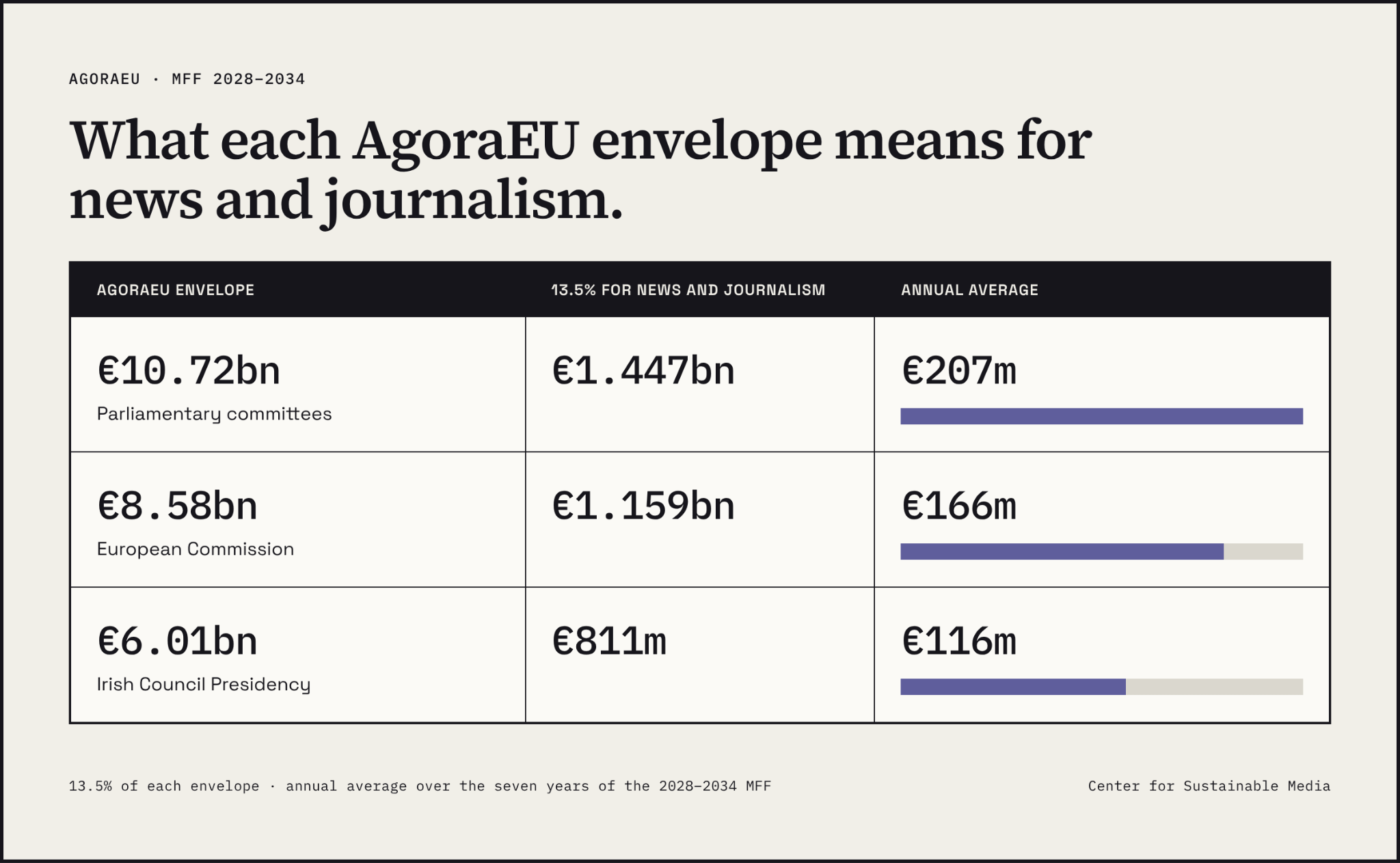
(You can also see plenty of other scenarios on the AgoraEU explorer page, now part of the Euros for News platform.)
Only the first row pairs a budget with a share actually proposed together. The Irish Presidency’s October proposal cuts AgoraEU by 30% from the Commission figure and leaves the internal split open. Our guess is that we end up below the middle row. At the Irish end of the range, we’d be looking at roughly half the €1.6 billion we once thought possible.
Parliament and Council negotiate the AgoraEU regulation together. The overall seven-year budget requires unanimity among member states and Parliament’s consent to the whole package. By the time agriculture, cohesion and defense are on the table, we struggle to picture a government holding out for a better deal for local newsletters.
Precisely because of this uncertainty, our position has always been that journalism should receive at least 16-20% of the AgoraEU budget, whether through MEDIA+ or a strand of its own. We’ll continue to make that case.
A grant you can afford to win
Our favorite part is Article 15. Grants could cover up to 100% of eligible costs, with more money paid upfront. The text calls for simpler procedures and gives a two-stage application as an example. Send a short proposal first and write the long and complicated one only if somebody is interested in your brief pitch. We put all three ideas in the policy platform that came out of our March policy lab. I’m allowing myself the possibility that somebody read it.
CSM is quite good at writing big, complicated applications. We can usually work with an 80% or 90% funding rate. A three-person publisher has to find the other 10% or 20%, pay salaries while waiting for reimbursement and take somebody off reporting to write a proposal that may go nowhere. The rules are identical across Europe, but the resources available to comply with them vary considerably.
The compromise explicitly encourages multiannual operating grants, which we have mixed feelings about. There’s a clear case for long-term core support where even a well-run outlet has little realistic prospect of earning enough to do the work. That may be true of an exiled newsroom, a local investigative nonprofit or a publisher serving a community where few readers can afford a subscription.
Elsewhere, I’d want public money to help publishers find out what people will pay for and give them enough time to build that income. This was one of the findings of Capital Stacks of Journalism. In quite different European markets, grants helped publishers get started, and earned income covered a growing share of the bills as the business developed. Where there’s a plausible market, the grant should leave the publisher better able to pay for its journalism when the funding runs out.
There are also strong references to intermediaries who could pass money on to smaller outlets without raising matching funds on the sums redistributed. Publishers and funders would have a formal opportunity to comment before the Commission adopts the work programs that shape the calls. These are all decent ideas.
Who gets to be local?
The stronger emphasis on local, regional and community journalism makes sense to me. A town can have more information circulating than anyone could reasonably consume and still have nobody paid to sit through a council meeting. That’s the market failure I’d spend public money on even if we could live without the term news desert.
We are considerably less enthusiastic about the passage that encourages support for public service broadcasters and their regional branches to provide local information. They could already participate; naming them gives them a stronger claim when the calls are written. Some produce excellent local journalism. But they also have what the grant-industrial complex calls absorptive capacity. A broadcaster can absorb in one award what a group of independent local publishers could put to work for years. We’ve had this concern before.
For a budget that runs to 2034, I’d be wary of giving today’s largest institutions a head start on the assumption that this is still where people will go for local information.
We welcome long-term support for investigations. Cross-border collaboration makes sense when the story crosses a border. As The European Correspondent reminded us last week, building a European public sphere is a worthwhile and difficult undertaking. So is covering a town where all the relevant people inconveniently live on the same side of the border.
The text also recognizes economic pressure as a threat to journalists’ safety. After watching the Orbán-government spend 16 years demonstrating what it could do to editors and reporters through the allocation of state advertising, we are glad the Parliament wrote that down.
The people who already have the audience
Both the Commission original and the new text mention creators. Funding desks would help independent creators apply, and a reporter publishing investigations on YouTube has a decent case for support. But when the text describes how journalism funding should work, it still mostly has organisations in mind.
I understand the preference. If the editor of a local paper gets ill or changes careers, there’s still a local paper. If your entire operation is one person explaining local politics on YouTube, quite a lot depends on how they feel about explaining local politics next Tuesday. Still, in this year’s Digital News Report, 27% of respondents across the markets surveyed got information from news creators every week. For a program that will run until 2034, I’d have liked either text to spend a little more time on how public money might support the people audiences already follow.
So where does today’s vote leave us? We know there’s a majority in the two committees for a dedicated journalism budget, easier access for small publishers and a few things I could have lived without. That gives Parliament a position to negotiate from. The member states still have the biggest say over how much money there will be. The Commission will write the work programs and calls that determine who can actually get it. Parliament has influence over both, and today’s vote settled neither.
This is the peculiar difficulty of covering the EU budget. Any one of these steps can turn out to have mattered enormously or disappear from the next draft. Add them all up and eventually somebody in a small newsroom opens a call, reads the eligibility criteria and finds out which it was.
By now, you too should be unable to say how much money European journalism will get. Which means it’s time to go and spread our ignorance.
(LENS EU, a project co-funded by the European Commission, supported the “Funding today” section of Euros for News, which explains how EU journalism funding currently works. Civitates supported the section on our policy platform and advocacy work. The editorial work in both sections is independent, and the views are our own.)