


Welcome!
This week on Media Finance Monitor
What are we good for?
What your open rate, conversion rate, and price should actually be
Local news is routine, but not automatic
24 active calls (2 new)
Media Finance Monitor is where newsroom leaders, funders, and media entrepreneurs come to understand how money really moves through the information ecosystem. We decode funding, business models, policy, and platform shifts and turn them into strategies you can actually use.
Paid subscribers get premium editions, full access to the archive and all our research reports, for about the cost of a pistachio éclair and a good espresso a month.
For deeper engagement, our Partnership Program offers one-on-one strategic advisory, curated briefings, and access to our internal databases and invite-only events.
Join as a free or paid subscriber.
What are we good for?
(by Peter)
A few years ago, I found myself at breakfast in a Brussels hotel during yet another two-day media funding event. You know the type: name badges, aggressively burgundy carpets, and people trying to solve the world’s wicked problems from panels and PowerPoint decks.
Suddenly a reasonably successful media investor sat down next to me. I introduced myself, and over dry scrambled eggs and soggy bacon, we started talking about public subsidies, private capital, and how to get more resources into public interest journalism.
At some point he told me to stop trying to prove journalism’s “societal” value. Go down that road, he said, and you’ll lose: some of the value is self-evident, and the rest is a fight you can’t win.
He was half right.
He had a point about the fight: set journalism against malaria nets in an aid budget and you will lose most days, and probably you should. But I think he was wrong that the value is self-evident. It is not evident to most funders, investors, to the audience and, if we’re honest, not always to ourselves. We need to understand what journalism is for, and not only when we’re asking someone for money.
Which is why I believe The Value of Journalism study (by Mel Bunce and Beth Pearson) is so important. It does the unglamorous work of gathering the evidence, and grew out of the research working group of the Media Viability Manifesto, where some of us spent last year arguing that the sector had to get better at demonstrating exactly this.
The strand I care about most is journalism as an economic enabler. The report presents evidence showing every dollar spent on journalism can return more than a hundred in recovered funds, better public services and lower corruption. A decline in press freedom tracks a one-to-two per cent fall in real GDP growth. In Uganda, publishing school budgets in local papers raised the share of funds actually reaching schools from 13 per cent to 80 per cent. None of this is self-evident, it had to be measured.
This is, of course, not going to change the minds of people who think “media freedom” is what happens when they personally own all the television channels. But there is a large and important group of decision makers who are neither hostile nor fully convinced. They have watched the business model collapse, platforms extract value, creators build direct relationships with audiences, AI take over search, and public trust in institutions weaken. They are asking legitimate questions. Is journalism still a business? Where is there market failure? What should philanthropy fund? Where can private capital help? When are public subsidies justified? And, perhaps most uncomfortably, are we trying to save something because it is valuable, or because we used to value it?
We really shouldn’t dismiss these questions and I think the report gets us a little closer to some of the answers.
Evidence of value is one argument; what to do with it is another. Reflecting on another, more recent media funding summit in Brussels (I swear these are like waffle kiosks in that city) Leonard Novy wrote about how newsrooms, and perhaps the wider sector needs to move from fundable to investable. It’s a great line, in large part because in 5 words it describes a process so painful and complex that many newsrooms don’t even attempt it.
Moving from fundable to investable means rebuilding almost everything about how an organisation runs, including the editorial side, which was never a separate thing. The durable ventures will be the ones that manage it, and most people underestimate how much of a retooling this actually requires.
A new brief titled Private Capital Mobilisation in Support of Media (by Clare Cook, Ole Dahl Rasmussen and Giordano Zambelli) maps that terrain.
It opens with two full pages of acronyms, which may frighten off the faint-hearted, but push past them: what follows is very useful. The brief works at two levels at once. It handles the macro, systems-level questions, how you build a market where one barely exists, while staying concrete about specific actors, specific instruments.
For a policy crowd, I think the value is in the comparisons. The brief looks at how agriculture and off-grid energy built their financing landscapes over two decades, pipeline-building, guarantees, sequenced capital, patient concessional money, and asks what transfers to media and what doesn’t. The honest answer is: less than you’d hope, but not nothing.
For an operator, it’s a different kind of useful. If you run a small independent newsroom and you’ve started wondering what investment might even look like, who invests, through which instruments, and you don’t already live in the world of impact finance, all of it sounds alien. This is as good a starting point as any, and there aren’t many starting points. And if you want to go deeper, get Aunnie Patton Power’s Adventure Finance, it is the clearest guide I know to how these instruments actually work.
Taken together, the two reports point in the same direction. We need better evidence about what journalism is good for, and better financial machinery to support the parts of journalism and media infrastructure that markets alone will not sustain.
What your open rate, conversion rate, and price should actually be
(by María)
In a first-birthday post for his Substack, Derek Thompson noted the newsletter had nearly 110,000 subscribers and a paid conversion rate of around 5.5%. He did not disclose his income, but said it had surpassed his former Atlantic salary after about five months and kept growing.
Thompson is an excellent and well known reporter. He is the ceiling, which is very useful to see, but the floor and the middle are where most of this market exists.
Beehiiv’s State of Paid Newsletters 2026 offers a wider view. Paid subscription revenue on the platform grew from $8 million in 2024 to $19 million in 2025, with $35 million projected by the end of 2026. The share of revenue-generating users earning through paid subscriptions doubled, from 15% in Q1 2024 to 30% in Q1 2026.
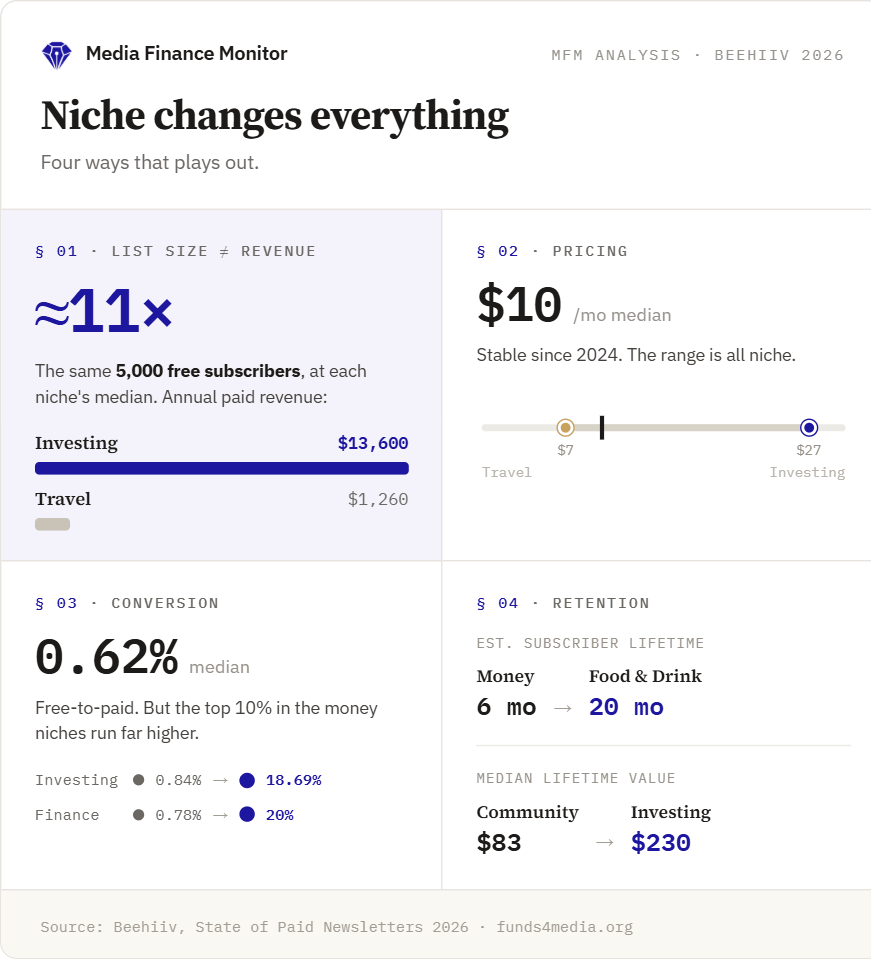
Pricing has a stable midpoint, but the range varies by niche. The median paid newsletter charges $10/month or $100/year, unchanged from 2024. Investing sits at the high ($27/month, $292/year); Travel sits at the low end ($7/month, $80/year).
Conversion rates are low at the median, but much higher at the top. The median free-to-paid conversion rate is 0.62% (about six paying subscribers per thousand free ones). Investing converts at 0.84% at the median and 18.69% for the top 10%; Finance at 0.78% and 20%. Sports has the highest median at 1.93%, but the sample size is relatively small.
Retention changes what each paid subscriber is worth. Estimated lifetime runs from about six months for Money to nearly 20 months for Food & Drink, with News close behind at around 18 months. Monthly churn moves in the opposite direction, from 16.67% in Money down to 5.06% in Food & Drink. Median LTV ranges from $83 in Community to $230 in Investing.
List size alone does not predict revenue. A 5,000-subscriber Investing newsletter, using median conversion and pricing, can generate roughly $13,600 a year. The same-size Travel list, at its median conversion and pricing, generates about $1,260.
Despite how well independents are doing, our review of 859 newsletters from 32 enterprise publishers across 10 European countries found enterprise publishers still underuse the format.
On an ever so slightly related note: we are the #10 newsletter on Substack in Hungary. We are not sure what this means, but◝(ᵔᗜᵔ)◜
Local news is routine, but not automatic
(by María)
A recent study from the Media Insight Project looks at how Americans across age groups get informed. It is based on a nationally representative poll of 1,009 teenagers ages 13-17 and 1,092 adults. The main frame is generational, but the section on local news includes findings worth a closer look.
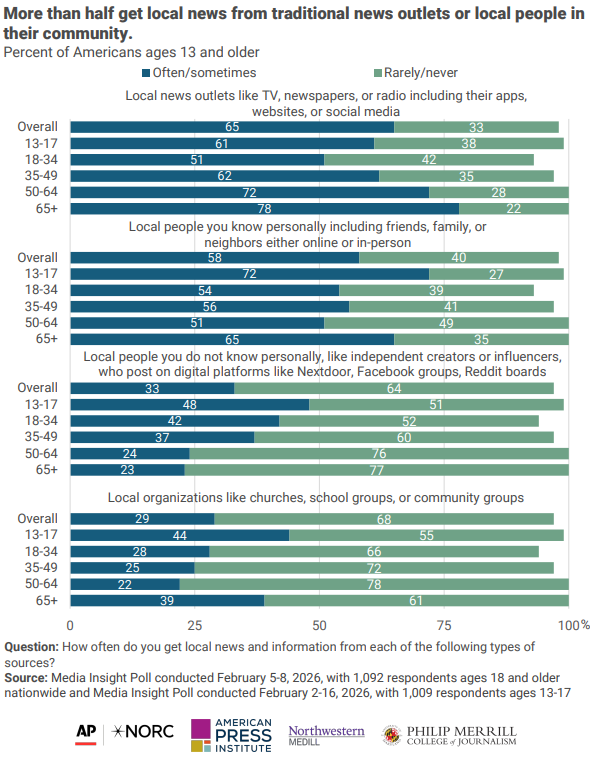
Local outlets still lead, but they are part of a wider information mix. Sixty-five percent get local news and information from them often or sometimes. But 58% get it from people they know personally, 33% from local creators or influencers, and 29% from community organizations. For publishers, the information market extends beyond newsrooms.
The most followed topics are practical and repeatable. Weather or traffic leads overall, at 65%, followed by crime and public safety, 49%, and government or politics close to home, 39%. These are everyday information needs, the kind that can bring people back to alerts, newsletters, guides or other service formats.
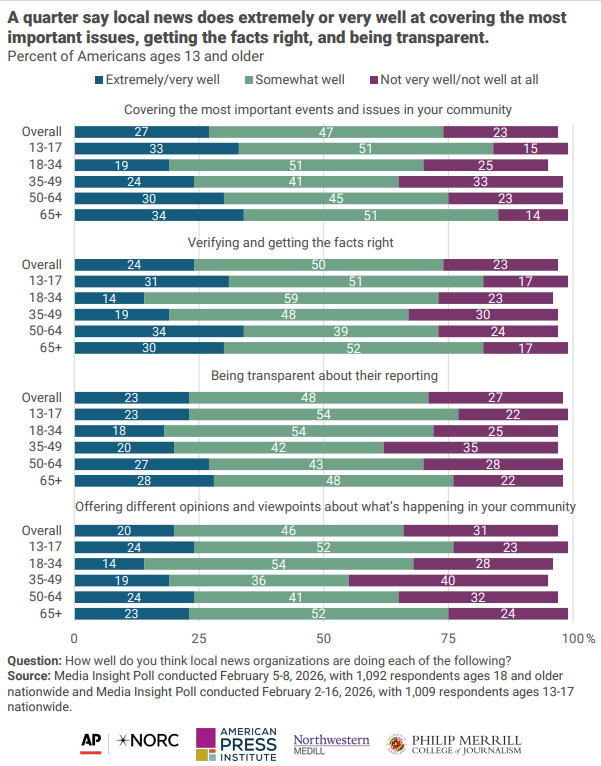
Regular use does not mean high marks. Local outlets are present in people’s information habits, yet the top-box ratings are modest: 27% say they do extremely or very well at covering important community issues, 24% at verifying facts, and 23% at being transparent. That presence can create openings, but durable revenue depends on becoming a source audiences value enough to return to, recommend or support.
Daily utility can open the door. The harder task is becoming distinct and trusted enough to be the go-to source people rely on, and turning that position into something they will pay for.

This piece is part of a series focusing on local and community journalism and is supported by the LimeNet project and the European Union.
Here are the 24 active calls (2 new), with the largest at the top: