


Welcome!
This week on Media Finance Monitor
The toxic story journalism tells its funders
Repression is an effective product manager
Second-hand fashion CEO invests in public-interest journalism
What the numbers say about local news sustainability
26 active calls (7 new)
Media Finance Monitor is where newsroom leaders, funders, and media entrepreneurs come to understand how money really moves through the information ecosystem. We decode funding, business models, policy, and platform shifts and turn them into strategies you can actually use.
Paid subscribers get premium editions, full access to the archive and all our research reports, for about the cost of a pistachio éclair and a good espresso a month.
For deeper engagement, our Partnership Program offers one-on-one strategic advisory, curated briefings, and access to our internal databases and invite-only events.
Join as a free or paid subscriber.
The toxic story journalism tells its funders
(by Peter)
Wednesday evening in Perugia, I found myself sitting across from a Russian editor whose work I admire. At some point bottles appeared, glasses were filled, and someone asked the standard question: red or white? There was chatter, people were distracted, and before he really noticed, someone had poured him white wine.
He looked at the glass, paused, and muttered something. I asked whether he had wanted red. He smiled, said it was fine, and then, half-jokingly, added that one of the first things you learn in exile is to drink only from bottles opened in front of you. I was enjoying my pasta with gorgonzola, beets and poppy seeds while he was doing an involuntary security check on a bottle of Orvieto.
Perugia is full of conversations about how hard journalism has become, and many of those conversations are justified. In some places, difficulty means broken business models, shrinking margins, exhausted teams and endless fundraising. In others, it means intimidation, surveillance, exile, and the need to think twice about something as ordinary as a glass of wine. Journalism operates across a very wide spectrum of hardship, and it helps to keep that spectrum in view.
We tell stories about what is broken in the world, often because that is the job. But living so close to crisis, fragility and failure means we also become very fluent in telling stories about our own challenges, whether objective or subjective, systemic or personal. And while many of those stories are true, I increasingly wonder what happens when they become the dominant way the sector describes itself.
Spend enough time around fundraising conversations and you start to hear a familiar narrative. Platforms extracted our advertising revenue, Big Tech swallowed our audiences, governments harassed us, underfunded us, or actively tried to destroy us. We deliver a public service that markets consistently fail to support. We are in trouble, again, still, send help!
To be clear, this is not a fabricated story, in many places, it is simply a description of reality. It can also be an effective one. Philanthropic funders often respond to the language of public value, democratic need and institutional fragility. Public sector funders frequently do too. Audiences, especially in places where independent journalism is visibly under pressure, can also rally around it.
But the same story that can unlock solidarity is often deeply unattractive to capital markets.
Risk capital does not flow toward sectors that have internalized their own decline. Investors - including impact investors, who care about more than pure returns - need a credible theory of how they get their money back. “We are a public good that markets consistently fail to support“ is not that theory.
Some publishers tell a different kind of fundraising narrative. They may still acknowledge the difficulty of the market, but they lead with momentum rather than precarity: they talk about the audience they serve, the product they are building, the niche they understand, the loyalty they have earned, the demand they can see. Their invitation is not to “rescue us”, it is to “come along for the ride”.
For capital markets, this is almost certainly the better fit. If journalism wants access to more of that capital, it cannot speak only in the language of crisis, it also has to learn to describe opportunity. This is a large part of why we launched the Capital Stacks of Journalism project in Perugia in collaboration with Milo Tesselaar.
The project looks at digital publishers founded over roughly the last 15 years, especially audience-revenue-first businesses that have actually made it to profitability. We want to understand who backed these companies, how much they raised, on what terms, how long it took to break even, whether anyone exited, whether anyone paid dividends, and what all this tells us about journalism as a business rather than a sector defined only by rescue narratives. We’re only at the beginning of this work, but already finding reasons for cautious optimism. Watch this space for updates.
Repression is an effective product manager
(by Peter)
On Tuesday I was in Vienna for an event called “Acht Tische für die Vierte Gewalt” (Eight tables for the Fourth Estate) an attempt by Gabriela Bacher, Sebastian Loudon and a large part of the Austrian media ecosystem to redesign the country’s journalism subsidy scheme. Between talking about the EU’s media funding mechanisms and eating Central Europe’s weirdest sandwich topped by something that felt like leberkäse in soft pâté form, I kept thinking about the contrast between the Hungarian and Austrian media environments.
Austria has a very generous subsidy regime for media and probably not unrelated to this, one of the most conservative media markets in Europe dominated by legacy players, with very few digital-native challengers. In 2026, the system still meaningfully rewards print production, which means people who want to do journalism sometimes end up launching print quarterlies they don’t actually want to publish, just to qualify for support. It’s not quite anti-innovation by design, but it gets there in practice.
Hungary is the opposite picture. For sixteen years, the Orbán government distorted the market not through a formal subsidy scheme, we don’t really have one, but through state advertising and coordinated pressure on private advertisers, allocated on political grounds. Almost all print was captured or compromised. Anyone who wanted to do quality journalism went digital and had more than a decade to figure out what worked. You now find local newsletters on Ghost and digital paywalls in small Hungarian towns. Repression, it turns out, is an effective product manager.
Brian Morrissey made a version of this point to me in Perugia: public sector subsidies can dampen innovation because they shield publishers from the market signals that force them to change.
The Austrian initiative proposes a new subsidy system that tries to avoid these traps. Less rewarding of incumbency, more oriented toward journalism rather than media formats, technology-neutral, with an independent commission in charge of allocations. It is an attempt at a genuinely hard problem: how do you underwrite independent journalism without insulating it from market pressures that keep it moving forward?
Vinted CEO invests in public-interest journalism
(by María)
At a founders’ summit in Palanga last summer, Thomas Plantenga, the Dutch CEO who took Vinted from a near-bankrupt Vilnius startup to one of Europe’s leading second-hand fashion platforms, stood up and pitched an idea: a charity endowment fund to finance a €200,000 annual prize for the best investigative journalism in Lithuania. He would put in €2.2 million personally, but needed others to make it large enough to last. The crowd of entrepreneurs did not hesitate. In fifteen minutes, they committed over €1 million in donations, a response he later described as unambiguous: “Lithuanians wanted to strengthen their democracy by celebrating their finest and bravest journalists.”
A team of volunteers was assembled afterwards to build the fund and an independent selection process. Six months later, Pamatai was operational, and by his account, the largest cash prize for investigative journalism in the world. It is now accepting nominations for works published in 2025. The selection committee includes Pulitzer winners Marina Walker Guevara and Bastian Obermayer, alongside other renowned international journalists and Lithuanian experts.
The award is only part of what the fund is designed to do. Its statutes also commit it to consulting for journalists and media organizations, public education on media literacy and corruption, mentoring programs for young people, and partnerships with international human rights and democracy organizations. Running all of that indefinitely, requires a financial structure to match the ambition. It is set up as a long-term investment vehicle rather than a spend-down pool: the capital is preserved and invested, with returns used to finance all the activities and the operating costs. The mandate is to generate stable, periodic income.
Plantenga has said he will continue working to grow the endowment.
What the numbers say about the sustainability of local news
(by María)
Pew Research Center published its most recent Local News Fact Sheet earlier this month, tracking Americans’ experiences with and preferences around local news since 2016. For sustainability, three categories are telling.
Attention: down by half. In 2016, 37% of Americans followed local news very closely. By the end of 2025, that share had fallen to 21%. This indicator has moved steadily downward for nearly a decade, mirroring a broader retreat from news generally. A less attentive audience is a harder monetize, regardless of how the ask is framed.
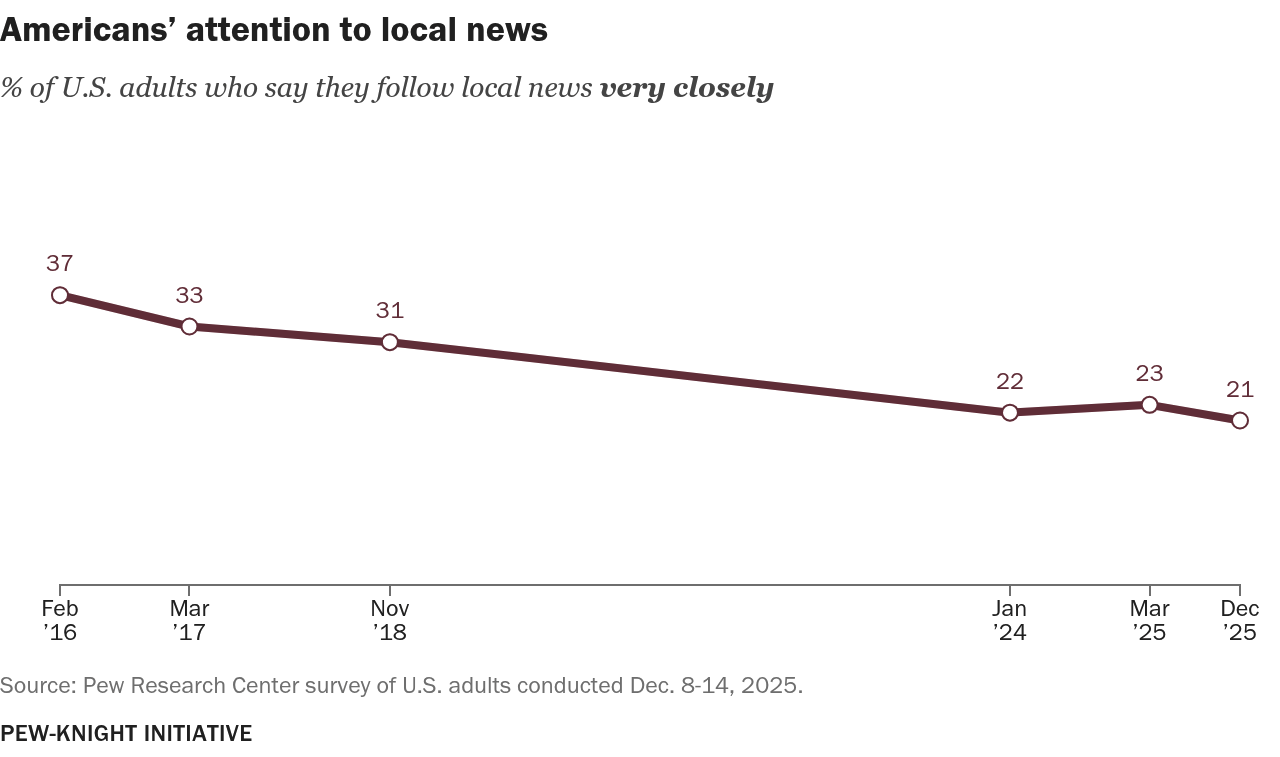
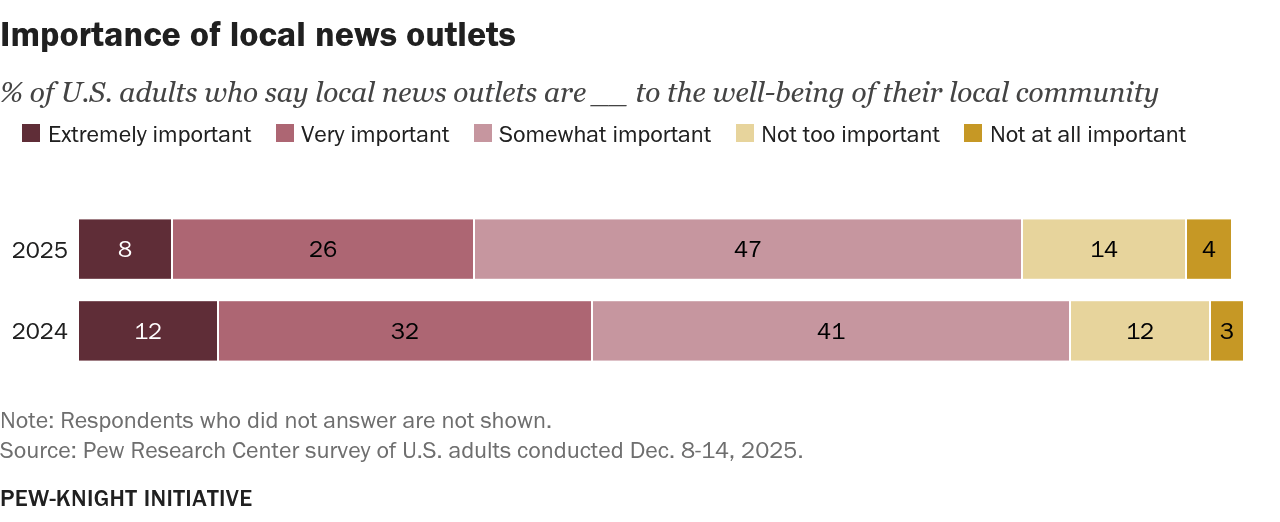
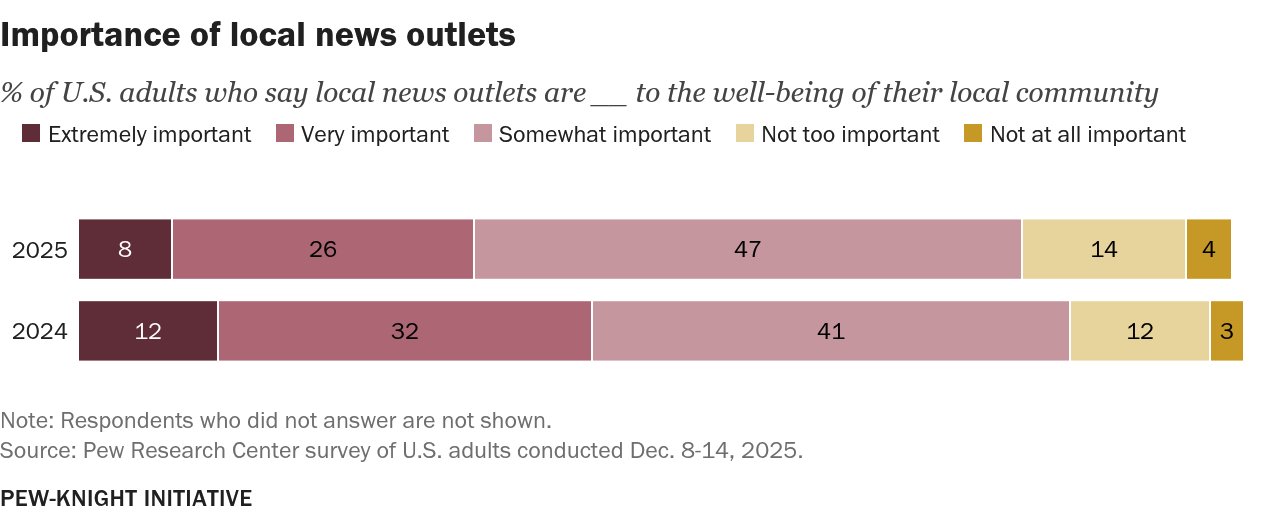
Perceived importance: eroding at the top. Eight in ten Americans still say local news is at least somewhat important to their community, but that broad agreement conceals a sharper shift: the share who say it is extremely or very important dropped from 44% to 34% in a single year.
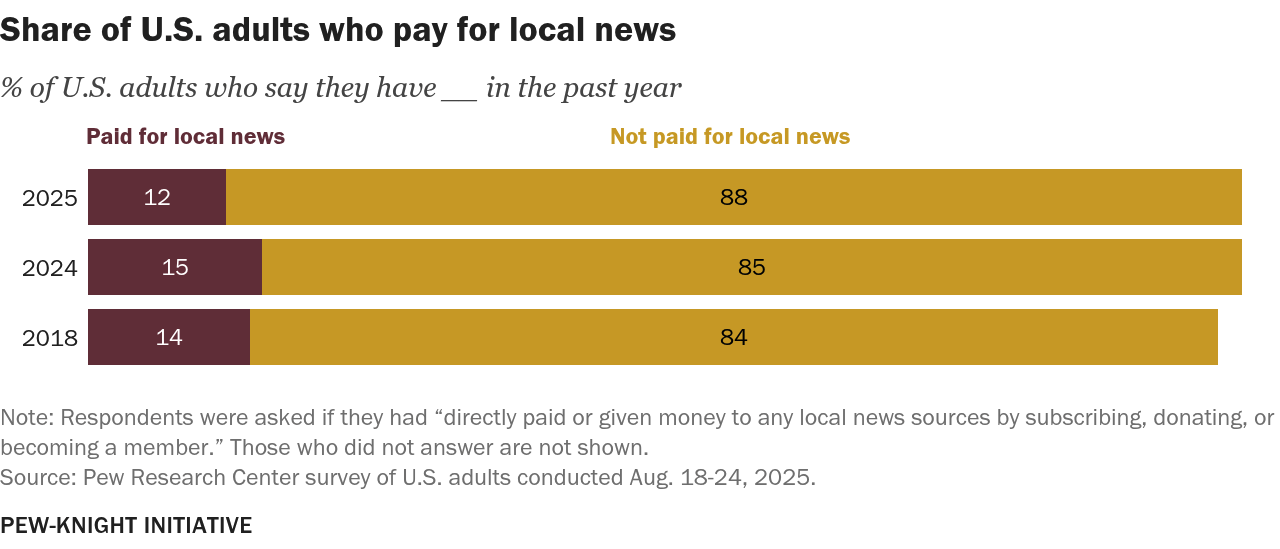
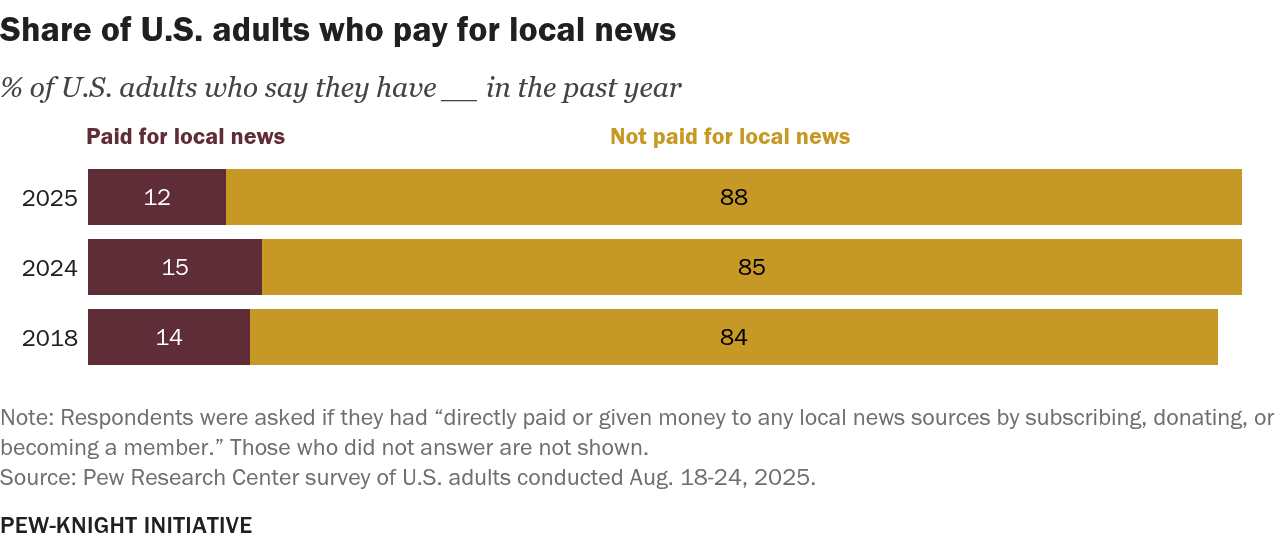
Paying: remains the exception, and it is not growing. Only 12% of U.S. adults paid or donated to a local news source in the past year, a three-year low and roughly the same as in 2018. Among those who haven’t paid, half say they can find enough for free, and a growing share (29%, up from 26% in 2018) say they are simply not interested enough. Price is the least-cited barrier. The willingness-to-pay problem is not a pricing problem.
While the data only covers the US market, the patterns emerging are likely not unique to it.

This piece is part of a series focusing on local and community journalism and is supported by the LimeNet project and the European Union.
Here are the active calls, with the largest at the top: