


Welcome!
This week on Media Finance Monitor
The slopulists are winning
The inbox is where the paying readers are
Media is investable, I have two biased sources
Gambling might finance even more journalism
What maturity looks like for independent local news
28 active calls (4 new)
Media Finance Monitor is where newsroom leaders, funders, and media entrepreneurs come to understand how money really moves through the information ecosystem. We decode funding, business models, policy, and platform shifts and turn them into strategies you can actually use.
Paid subscribers get premium editions, full access to the archive and all our research reports, for about the cost of a pistachio éclair and a good espresso a month.
For deeper engagement, our Partnership Program offers one-on-one strategic advisory, curated briefings, and access to our internal databases and invite-only events.
Join as a free or paid subscriber.
The slopulists are winning
(by Peter)
The great Lucy Kueng posted a super interesting working paper earlier this week on generative AI and self-published fiction. The researchers analysed 14,419 self-published, genre-fiction books sold on Amazon between 2023 and 2026. Books in which they detected substantial AI-generated text (more than 25 per cent) generally sold fewer copies. But they were not commercially irrelevant. Some reached meaningful scale, entered Top-25 rankings and took a growing share of sales.
Meanwhile, the overall supply of books exploded in these 3 years. The number of books recording sales in a quarter grew 19-fold compared with 2023; revenue grew ninefold.
The numbers are really fascinating (or maddening, depending on what you think about AI generated content.)
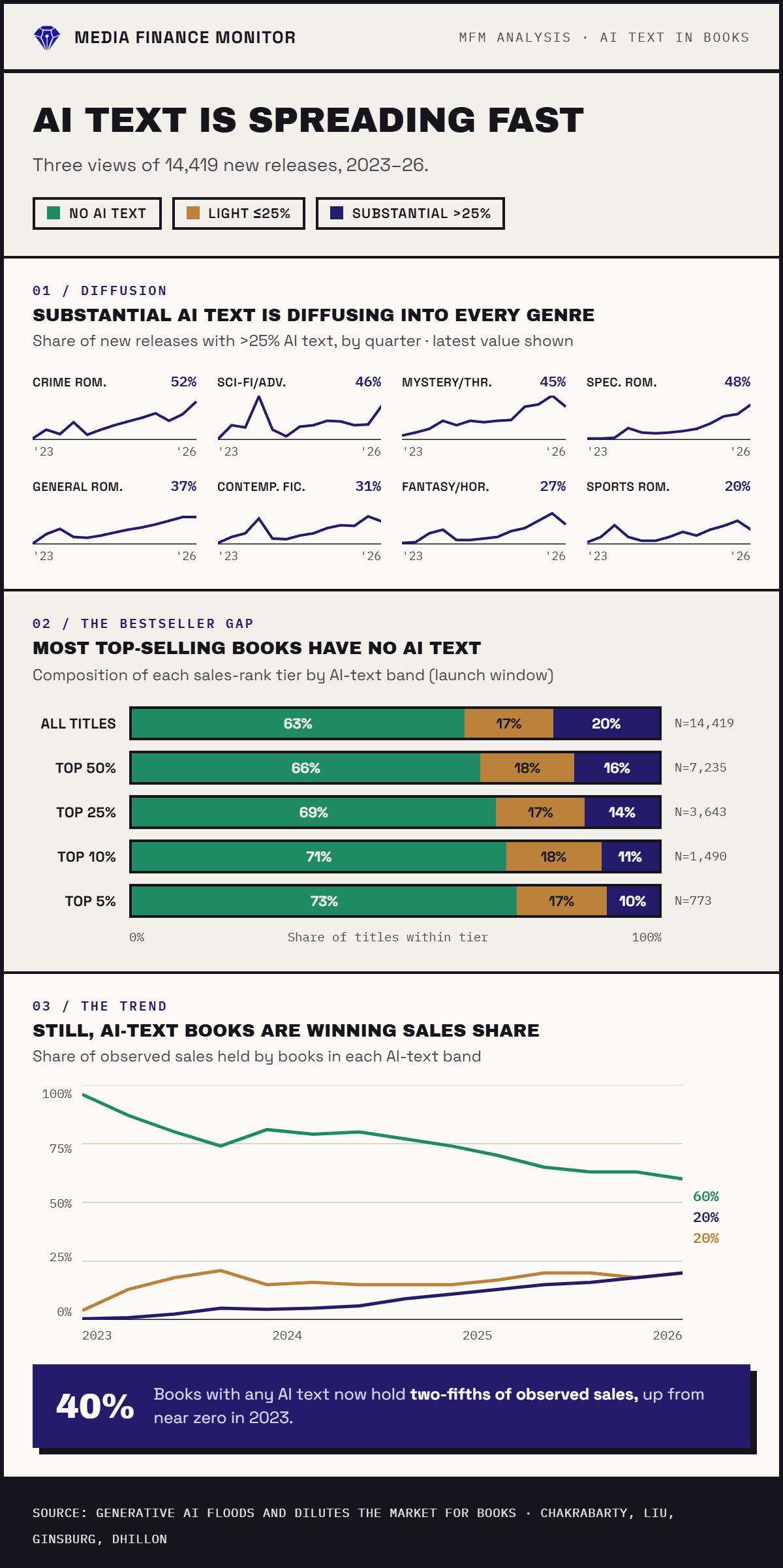
To me, this looks like evidence for something creative industries prefer not to hear (and something I’ve been harping on for a while): consumers care less about the production process than producers do.
We spend our lives making things, so the method feels central. Was this beautiful, elegant, whimsical sentence written by hand? Was AI used only for editing, or also for drafting? Which model? Was the prompt sufficiently artisanal? We then project this obsession onto the audience.
On the other side of the transaction, most consumers are buying an outcome. Did the book entertain them? Did the article explain something? Did the newsletter help them make a decision, feel clever, feel less alone or avoid wasting money? (In case of this specific newsletter, the answer to all of that should be an easy yes.)
AI use may impact the answer to these questions, but provenance is not, for most people, the product itself.
The study does not prove that readers are indifferent to AI. The books did not disclose its use, and the researchers identified it using detection software. We do not know how buyers would have behaved if every title carried a large MACHINE-MADE sticker. But it does show that substantial AI use does not automatically prevent a product from satisfying demand.
There is still a market for craft. The Atlantic can sell distinguished human writing, just as Hermès can sell a handmade bag. Some audiences will care deeply about provenance and pay a premium for it, that is a perfectly legitimate and viable business. But it’s clearly not the whole market.
The new Pangram integration on Substack lets readers request an estimate of how much of a post was written by hand or with AI assistance. The result appears only to the reader who asks for it. I think it’s a great feature, which suits Substack’s positioning as the home of quality writing. It is still somewhat inaccurate (it incorrectly says this post is 100% human made even though I used AI for editing). I am also curious how many people will use it repeatedly, and, having discovered AI in something they previously valued, actually stop reading.
My guess is: not that many.
For the record, we use AI throughout our work. English is not my first language. Media Finance Monitor has a two-person editorial team, and for both of us it is the side job of a side job. ChatGPT, Claude and Gemini help us research, edit, design and build. Our dashboard explaining the European Parliament’s amendments to AgoraEU is more useful than the long article I could have spent 6 hours writing and you could have spent eight minutes not reading. I’d like to think I was still needed, Ethan Mollick calls this co-intelligence.
Whether AI is good for the labour market, the climate or the soul is above this newsletter’s pay grade. But should small information businesses use it? To me, that is barely a question at all.
The inbox is where the paying readers are
(by Peter)
A significant share of modern office work consists of moving from an inbox to a browser tab and back again. Publishers may have underestimated the strategic importance of this extremely sophisticated workflow.
Greg Piechota writes in INMA about a new Northeastern University study that tracked the desktop browsing of 4,608 US adults. Email absorbed 24.9 per cent of their online time, almost level with social media at 25.3 per cent and nearly ten times the 2.5 per cent spent on news websites. Gmail alone accounted for 16.4 per cent of all browsing time. The average participant spent more time there than on the bottom 300,000 websites combined.
The study only captured personal desktop use, excluding work computers and mobile devices. For the professional classes, who spend much of their working lives inside Gmail and Outlook, the inbox may occupy an even larger share of the day.
These are also the people most likely to pay for information products. Our audience surveys across ten European markets show a close correlation between newsletter consumption and willingness to pay for online content.
INMA’s own benchmarking data points in the same direction. Across 317 news brands, publishers with greater newsletter penetration also tend to have more digital subscriptions. This is correlation, not causation: newsletters may generate subscriptions; paid subscribers may sign up for newsletters; strong media brands may simply produce more and better stuff. Still, the median publisher’s newsletter audience is six times larger than its subscriber base. That is quite a lot of potential customers sitting in one of the few remaining channels the publisher controls.
For much of the paying audience, the inbox it is the internet’s front page.
Before the summer, we published our own European Enterprise Publisher Newsletter Report, analysing 859 newsletter products from 32 publishers across ten markets. We found an industry that has deployed newsletters widely without really developing them as premium products. Some 83 per cent are free. Standalone paid products remain rare. Only one in six publishers features a newsletter above the fold on its homepage, while almost half show readers no content sample before asking them to subscribe.
Enterprise publishers still mostly use email as a pipe back to the website. Meanwhile, Substack and the wider newsletter creator economy have demonstrated that the email itself can be the premium product.
You can also browse all 859 newsletters in our explorer, including their topics, cadence, send days, access models and signup flows. Click around, I promise it is more interesting than a database of 859 newsletters has any obvious right to be.
The research was sponsored by FatChilli, they are the reason we could make it available for free. They will run a practical newsletter masterclass this autumn covering strategy, editorial choices, audience growth and technology. You can still register your interest here.
Media is investable, I have two biased sources
(by Peter)
MDIF and I have had a long relationship across a great many things. As usual, this is both a disclaimer and a brag. It also means I never feel like the ideal messenger for MDIF-related news.
Still, its 2025 Year in Review is worth a look.
At the end of 2025, MDIF managed $119 million across 56 companies in 31 countries. During the year, it made $9.7 million in cash investments, added six companies, collected $1.4 million in interest, dividends and capital gains, and recovered $1.53 million in principal. Five companies left the portfolio after repaying in full.
The report also lets you follow five years of assets, investments, returns and portfolio changes. Rather than venture-capital fireworks, consider this evidence that patient, flexible capital can move through independent media and come back.
Media is investable.
If 30 successful years of MDIF do not convince you, please wait for our Capital Stacks of Journalism report, launching on 29 September. I am currently spending most of my waking hours writing it, thinking about it and moving design elements by three millimetres. I am biased about this one too, but it will still be excellent.
Gambling might finance even more journalism
(by María)
Prediction markets (~gambling) have spent the past year moving deeper into mainstream media. Eventual is a new publication built specifically around them. Founded by Alex Keeney, who previously wrote and produced podcast about the sector, the outlet publishes daily articles, free and paid newsletters and a twice-weekly live show. Polymarket is its exclusive data partner and launch sponsor. The company plans initially to rely on advertising and sponsorships before adding enterprise data products.
The venture shows a wider opening for information businesses around prediction markets.
Platforms have already found reasons to work with established media. Kalshi and Polymarket have already brought their data into established news products through partnerships with CNN, CNBC, Yahoo Finance and Dow Jones. Those arrangements put prediction-market prices in front of much larger audiences while associating the platforms with major media brands. Regular reporting takes a bet beyond the trading screen: it explains why the odds are moving and turns an isolated wager into a story audiences can follow. Eventual is building an entire publication around that work.
But the commercial opening extends beyond attracting audiences and doing promo work for these betting platform.
Information becomes especially valuable when it helps someone make money or avoid a loss, creating demand for research, data and analysis. Financial markets have long rewarded people who understand a company’s performance or anticipate a regulatory decision before either is fully reflected in prices.
Prediction markets extend the same mechanism to elections, appointments, court rulings, speeches, conflicts and other events that can be made tradable. They turn information asymmetries and/or judgment into positions that can pay. Kalshi CEO Tarek Mansour has described the ambition as making any difference of opinion tradable. Publications, intelligence services and market tools can sell research, data or analysis to traders, funds and companies trying to sharpen their estimate of an outcome. Journalism can also give them that edge.
The morality of this, of course, is very complicated. A White House teleprompter operator reportedly made more than $100,000 on Kalshi betting on words from Donald Trump speeches he knew in advance through his job.
As more events become tradable, more information acquires commercial value. Media and other information ventures, journalism included, have an opportunity to capture some of this, but they need to navigate some very thorny ethical dilemmas.
What maturity looks like for independent local news
(by María)
LION Publishers has turned data from its Sustainability Audit into a public dashboard containing 480 completed audits from 438 independent news businesses in the US and Canada. It brings together self-reported figures on revenue, cash, audiences, staffing and operating practices, allowing users to compare different parts of the sector.
The framework assigns each result to one of four stages: Preparing reflects foundational work (12%); Building, the formalization of operations (62%); Growing, greater viability and expansion (24%); and Sustaining, the capacity to absorb disruption and plan beyond immediate survival (2%).
The figures below show where those differences appear.
Financial position and audience size
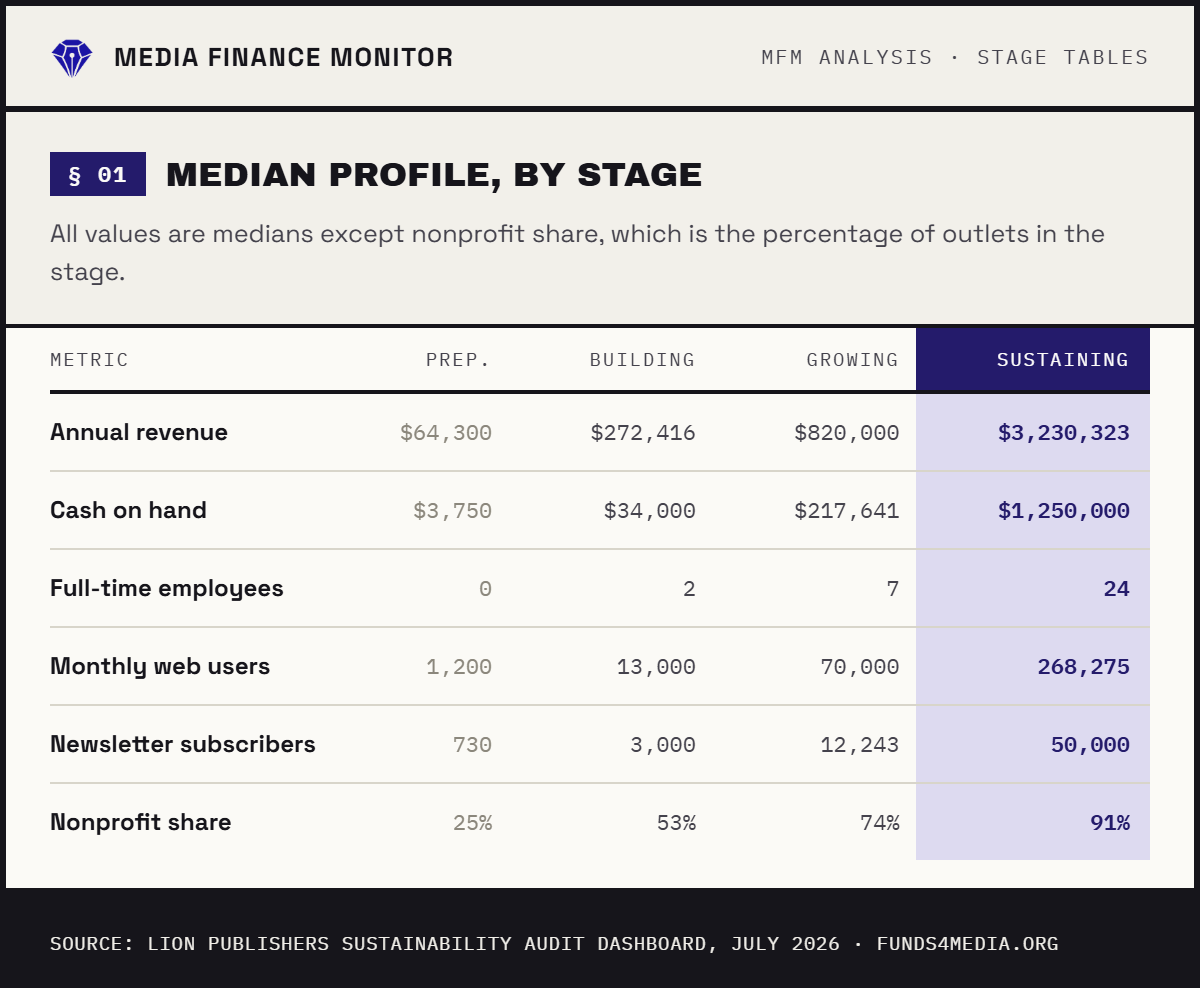
Annual revenue rises at every stage, but cash on hand climbs more steeply. The later groups appear to have a larger buffer against payment delays or a weak quarter. Since these are separate medians and do not count for expenditure, they suggest stronger liquidity rather than runway.
On the audience side, web reach outpaces revenue growth in the first two comparisons. Between Growing and Sustaining, both increase at nearly the same rate. Newsletter lists expand more steadily throughout.
Staffing outside the newsroom
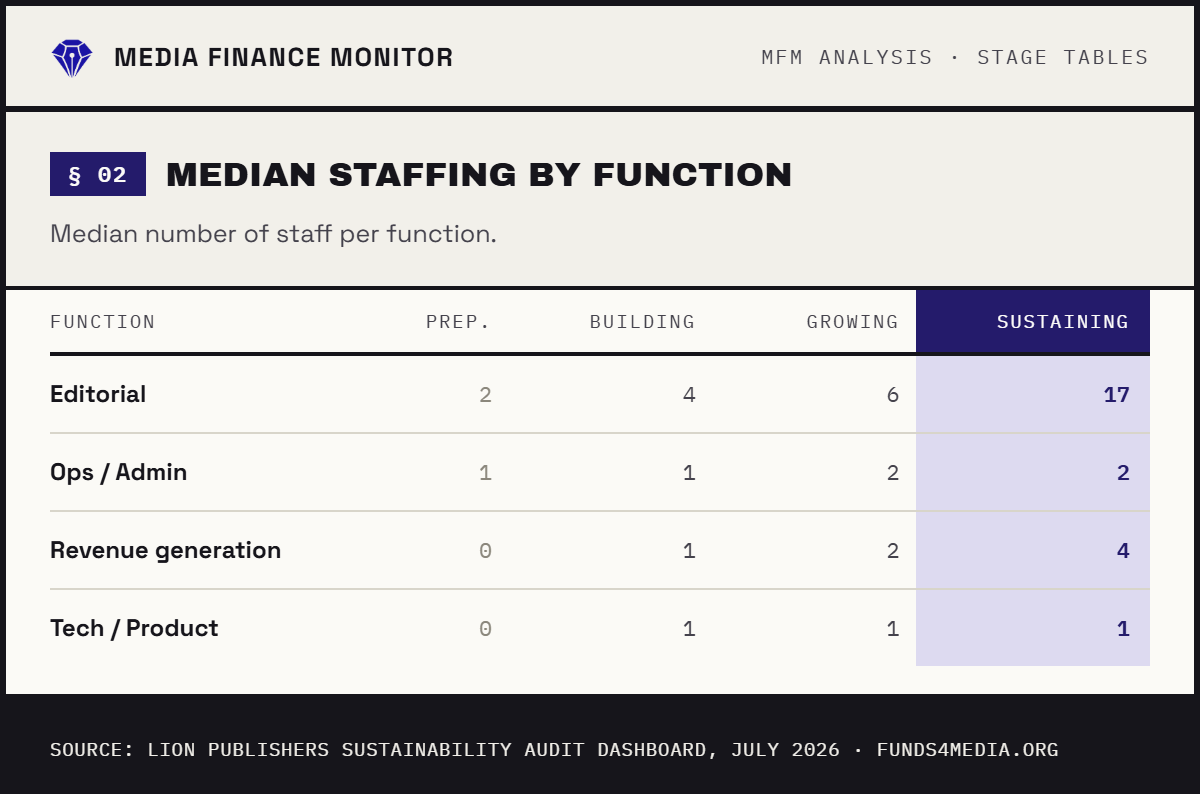
Non-editorial capacity expands selectively. Operations staffing remains limited, while tech/product reaches a median of one person and stays there. Revenue is the only support function that gains depth at each stage. The pattern is consistent with commercial work moving from shared responsibility to a dedicated team, without creating a large back office.
Internal systems and audience insight
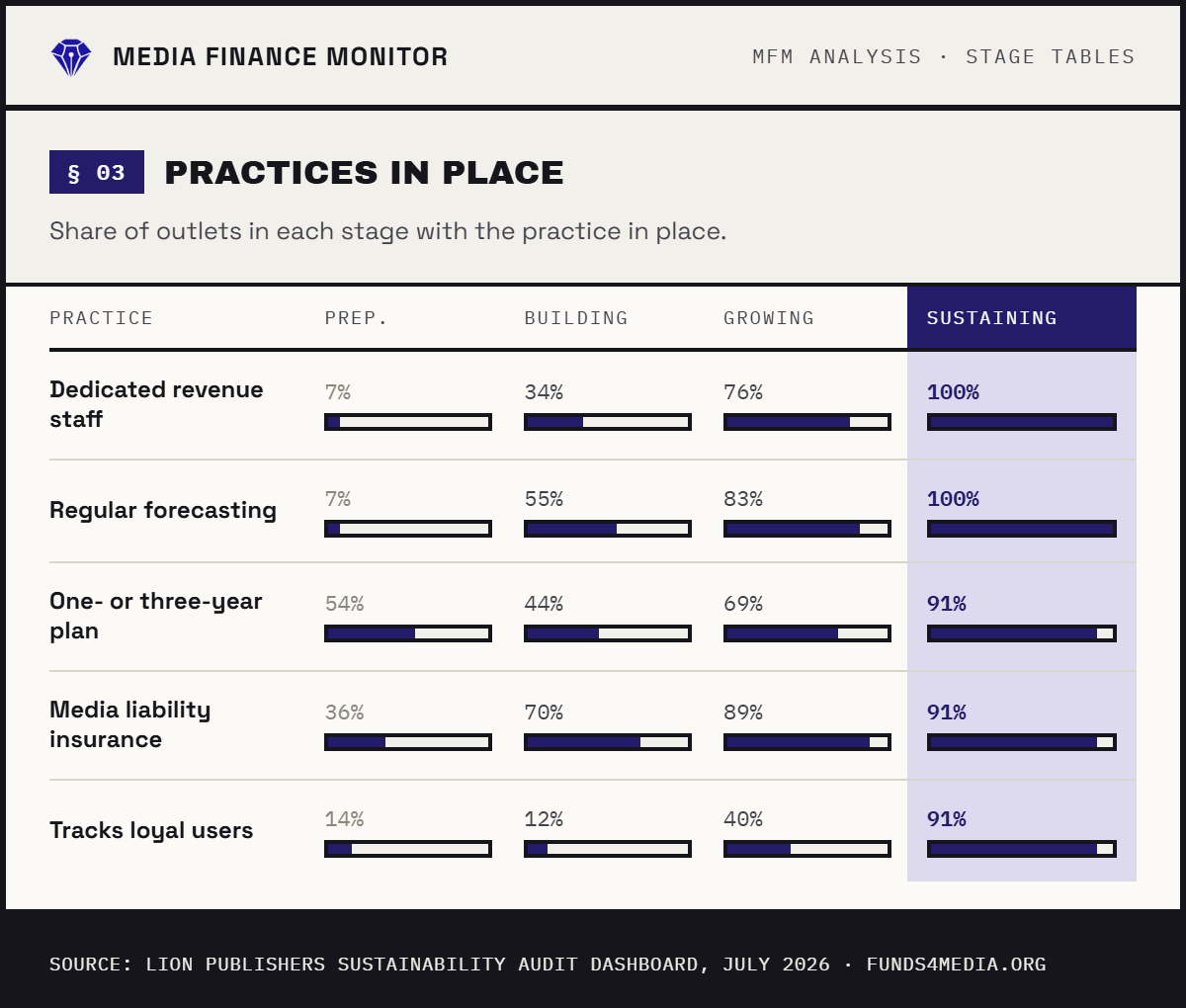
Most of the measured practices are already common by the Growing stage. Tracking loyal users is the exception, becoming widespread only in Sustaining. What sets the final group apart is this knowledge of who returns and how those relationships may translate into financial support, rather than another internal process.

This piece is part of a series focusing on local and community journalism and is supported by the LimeNet project and the European Union.
Here are the 28 active calls (4 new), with the largest at the top: