

Last week the Boston Globe published a feature about a lesbian bar in western Massachusetts that still required KN-95 masks, but decided to make Saturdays mask-optional in the hopes of attracting more patrons. The decision split the community and resulted in drama on a cosmic scale.
It’s the kind of piece that makes you smile, shake your head and then suddenly choke on your can of Cola Zero spit, cough and laugh at the same time as one protagonist decided enough was enough and proceeded to enroll in clown school.
The story, like all others on the Boston Globe, was placed behind a paywall. It generated a thousand new subscriptions on the first day, “several thousand“ within seventy-two hours, “many thousands“ by this week, according to the Globe.
In the subscription business, you’d call the Boston Globe a “mature product”, which means it’s a 150+ year old brand that had a digital paywall for 15 years. This makes this result simply incredible. But it’s nowhere near the record.
€4 million, for an article anyone can read for free
In January 2024 CORRECTIV, a nonprofit investigative newsroom in Germany, published “Secret Plan Against Germany“: the reconstruction of a meeting near Potsdam where AfD politicians and far-right activists were presented with a plan for the “remigration” of asylum seekers, foreigners and “non-assimilated” citizens. Within weeks, hundreds of thousands of Germans were in the streets. It also became a theatrical production staged by more than 70 theatres: another way to reach people who might not sit down with a long investigation.
Media Finance Monitor is where newsroom leaders, funders, and media entrepreneurs come to understand how money moves through the information ecosystem. We decode funding, business models, policy, and platform shifts and turn them into strategies you can actually use.
Paid subscribers get premium editions, full access to the archive and all our research reports, for about the cost of a pistachio éclair and a good espresso a month.
For deeper engagement, our Partnership Program offers one-on-one strategic advisory, curated briefings, and access to our internal databases and invite-only events.
I was vaguely aware of the piece until earlier this year. We were deep in Capital Stacks research and Márton Sarkadi-Nagy, our lead researcher and an excellent investigative journalist, was working through the statutory filings when he flagged an anomaly: CORRECTIV’s revenue had nearly doubled in a year, from €4.8 million to €9.4 million. It wasn’t immediately obvious why, so he went digging and came back with a preposterous idea: one investigation the newsroom published brought in north of €1 million. I thought that was impossible, but created a note for our interview with CORRECTIV’s David Schraven and Florence Wild. They told us their estimate was closer to €4 million in additional audience support. Thank God I wasn’t drinking Cola Zero.
Is this really the most lucrative piece of journalism ever published? I cannot prove it with 100 percent certainty. But it surely is a contender and shows clearly that people are willing to pay for public interest journalism.
This is just one story from Capital Stacks of Journalism, the project I have been mentioning here with considerable restraint. (You may remember this differently.)
Over the past eight months, we examined more than thirty European ventures and selected 21 financially viable outlets. We analysed filings and other public information, interviewed founders and executives, ran a comparative survey and logged more than 1,500 team hours. The purpose is practical: show how journalism businesses can be built, financed and made investable.
This is deliberately a study of survivors, so it cannot tell you how often similar choices fail. But it contains what I’d consider great stories/findings about media business and today, I’m going to share six more.
Who doesn’t want to be a millionaire?
French B2B publisher Contexte started with €100,000 in equity in 2013 but received €1m over its first two years from a Google-funded press innovation fund. It broke even in year one, but CEO Jean-Christophe Boulanger largely dismisses that milestone: finding the right product–market fit took three years.
In 2022, an international competitor offered €12m to buy it. The accompanying message was not very friendly: sell, or we will put the money into building a competitor.
Boulanger owned 65%, so a sale would have been quite the windfall for him personally. He told us he went on a little bit of a walkabout before saying no without negotiating a higher price. Since then, Contexte expanded their business successfully and now operate an English language vertical in Brussels.
Grants can create dependencies, and core grants can be corrosive. But the other thing they can do is buy a founder three years to find the product, and the confidence to refuse millions for it.
Finding your dream investor through an online contact form
Some founders found money easily. Tomáš Bella of Denník N raised €1.2 million from six of Slovakia’s richest men in what he describes as one meeting. Joshi Herrmann of Mill Media wrote down twenty-five names, and twelve invested. Zetland’s founders worked out who the mystery donor behind a new Danish party was and phoned him to say they want to do with the media space what he had done to politics. He said he had been waiting for their call and became the anchor investor.
For others, finding investors was considerably more difficult. 444’s founders spent nearly two years failing to raise, because almost everyone was afraid to put money behind an independent news site in Hungary.
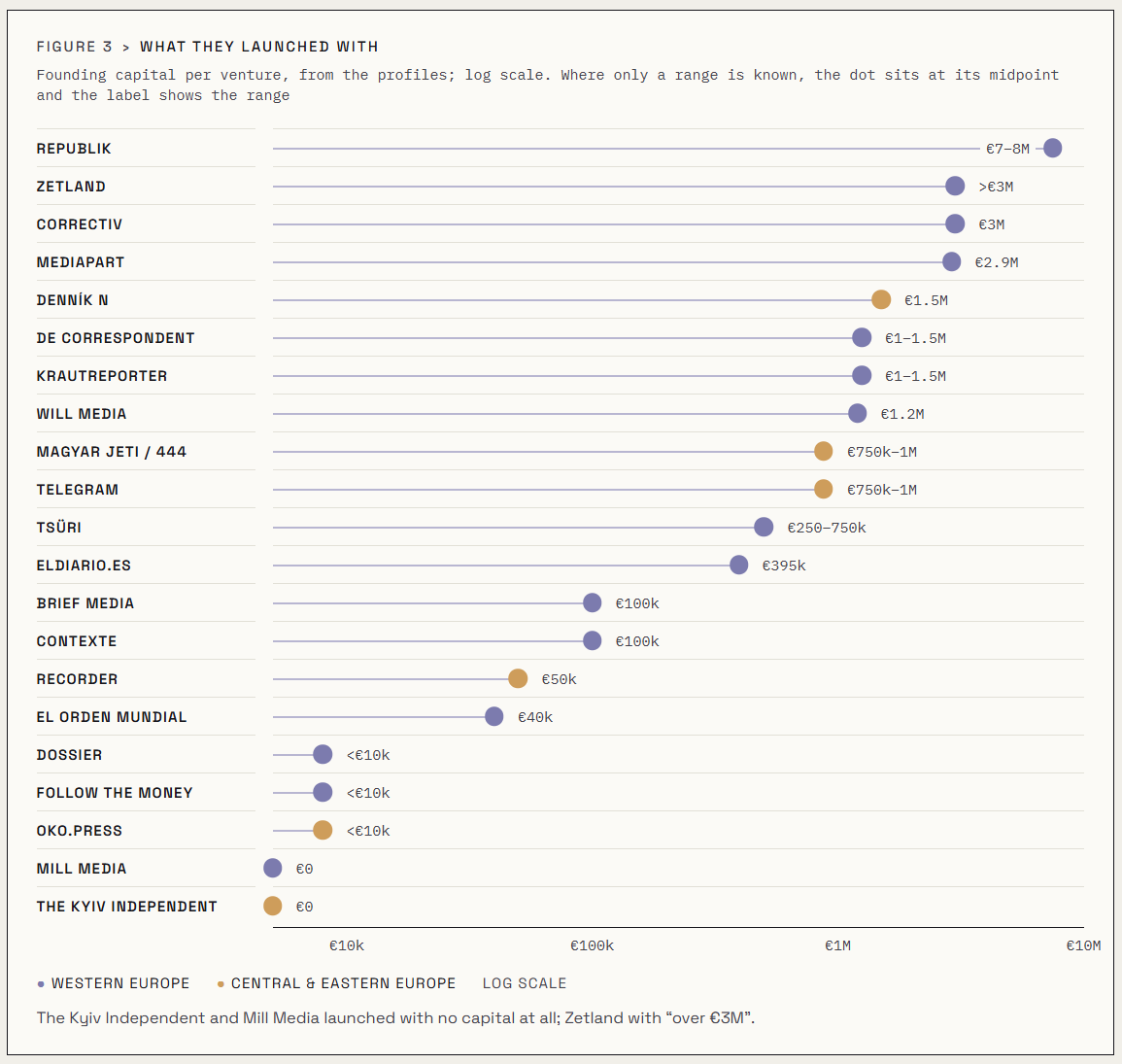
But my favorite story is from Croatia. Telegram’s CEO, Miran Pavić, read a blog post announcing Pluralis, a new fund for media in captured markets, filled in the form on its website and heard nothing for months. The reply came two weeks after a trade-press story about Telegram’s subscription growth. Ten months of due diligence later, Pluralis was in. (Pluralis is managed by MDIF, which we work with a lot. MDIF was not involved in the study, or in this newsletter.)
Eight added gates, nobody removed one
Audience revenue was an eligibility requirement, so finding it everywhere was unsurprising, but its importance was still striking.
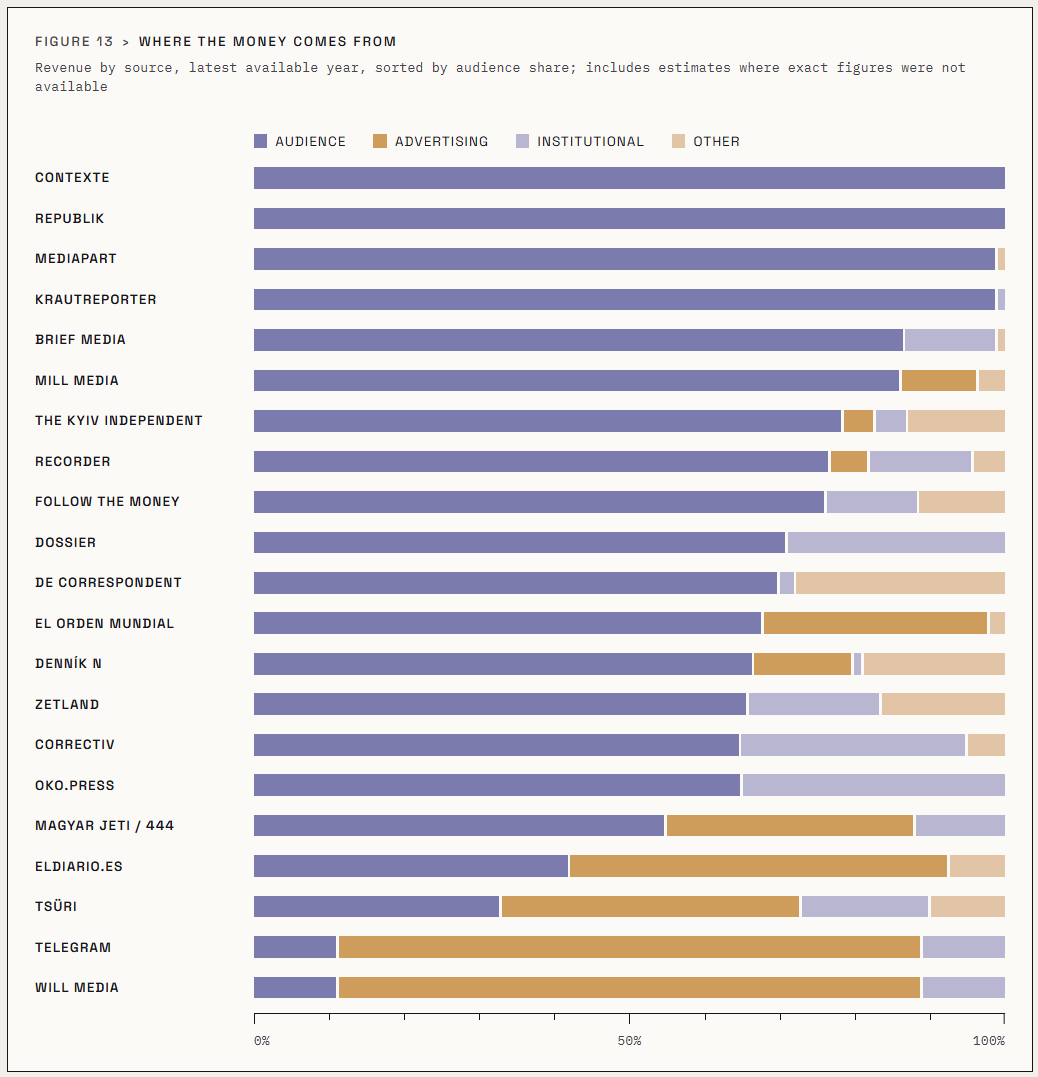
Nine outlets charged for access at launch; seventeen do today. Eight added a gate. None removed one. Only four still leave their core journalism entirely free.
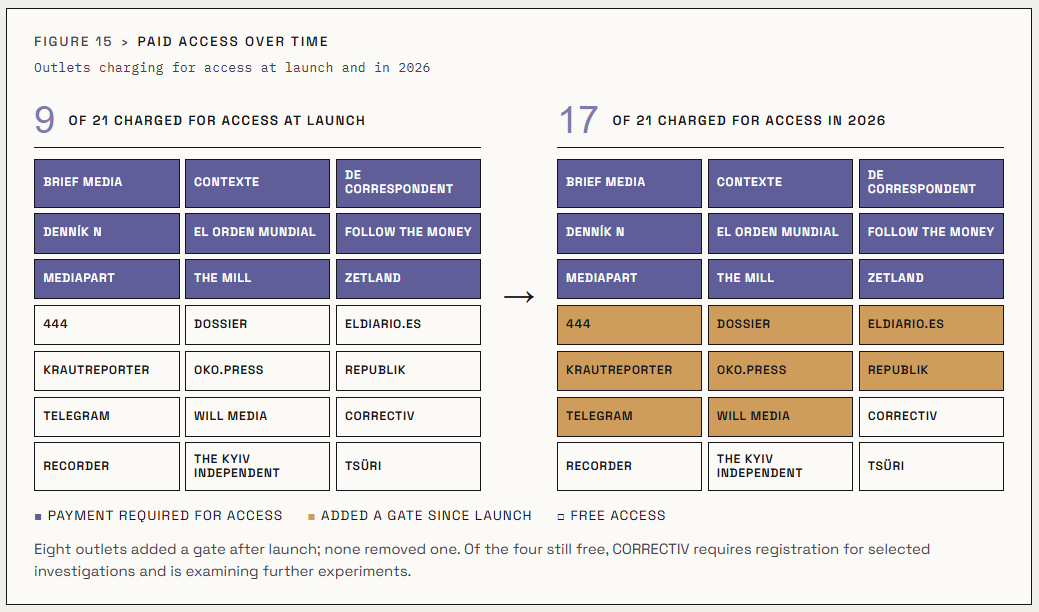
Paywalls involve trade-offs, but impact and paid access can coexist. Often, people who value your journalism need a transaction, an exclusive product or a nudge before they pay. Correctiv’s exceptional result does not make voluntary donations universally sufficient.
444 has a paywall; its clemency investigation helped set off the scandal that brought down Hungary’s president in 2024. (I helped introduce the paywall, but had left before that story.)
Most everyone prices like a cause
Across roughly fifty hours of interviews, nobody reported a disastrous price increase. Remember the survivor bias, maybe someone raised their prices and died for it, but still. CEOs and managers of these information ventures repeatedly told us about how anxious they were before raising prices only to find out that readers were happy to pay more. Founders repeatedly underestimated what their readers were willing to pay.
Contexte is the only venture not timid about pricing, and their CEO told us it took them years to get over their nerves. Now, there is no individual online checkout, a sales team assesses every client individually, assesses their needs and usage and makes an offer. Contracts average around €9,000 annually.
The best acquisition channel for this digital product is in print
The best-performing acquisition channel at Follow the Money, a digital-native investigative outlet in the Netherlands, is a full-page advertisement in a printed Saturday paper, with a QR code in the corner: about €55 per new member, against a lifetime value of roughly €300. Krautreporter in Germany found its readers on Pocket, a read-it-later app that no longer exists.
Yet several publishers, including large and mature ones, still cannot tell you what acquiring a customer costs. One did not build a marketing department until its ninth year. Growth expertise is scarce, and some newsrooms still regard marketing as faintly disreputable.
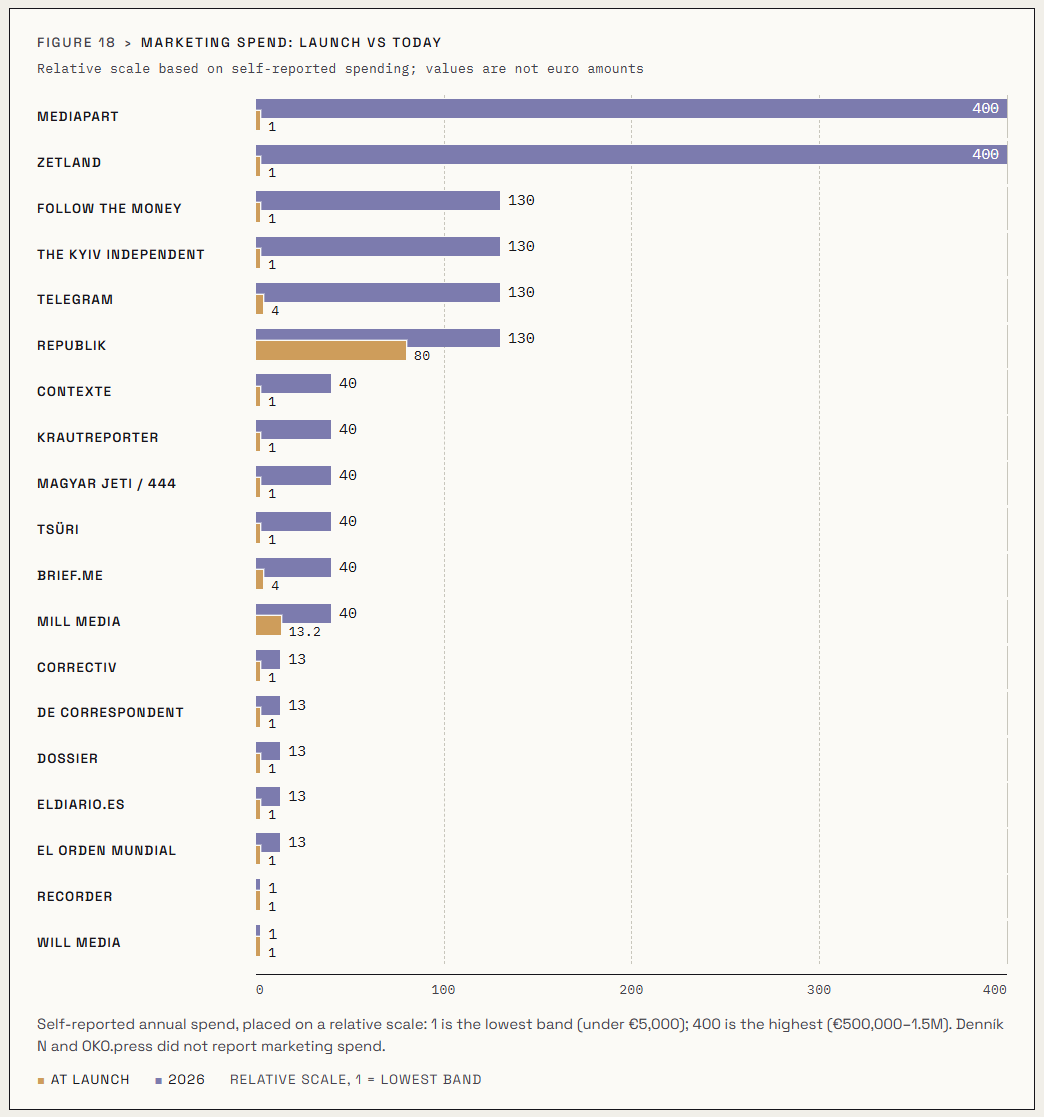
Part of the reason may be cultural. One publisher put it plainly: “I always said we will never have a marketing department,” and did not build one until the venture’s ninth year. Beneath this lack of intentionality lies a belief that the value of public-interest journalism should be self-evident, while marketing belongs to a more commercial, faintly tainted world. Growth expertise is also scarce and expensive.
The newsroom cannot do this alone
Mediapart launched with twenty-four reporters and few other staff, underestimated its commercial and technical needs, and almost died for it. Today its staffing is roughly half editorial, half everything else. In 2025, it generated €28.1m in revenue and €4.4m in profit.
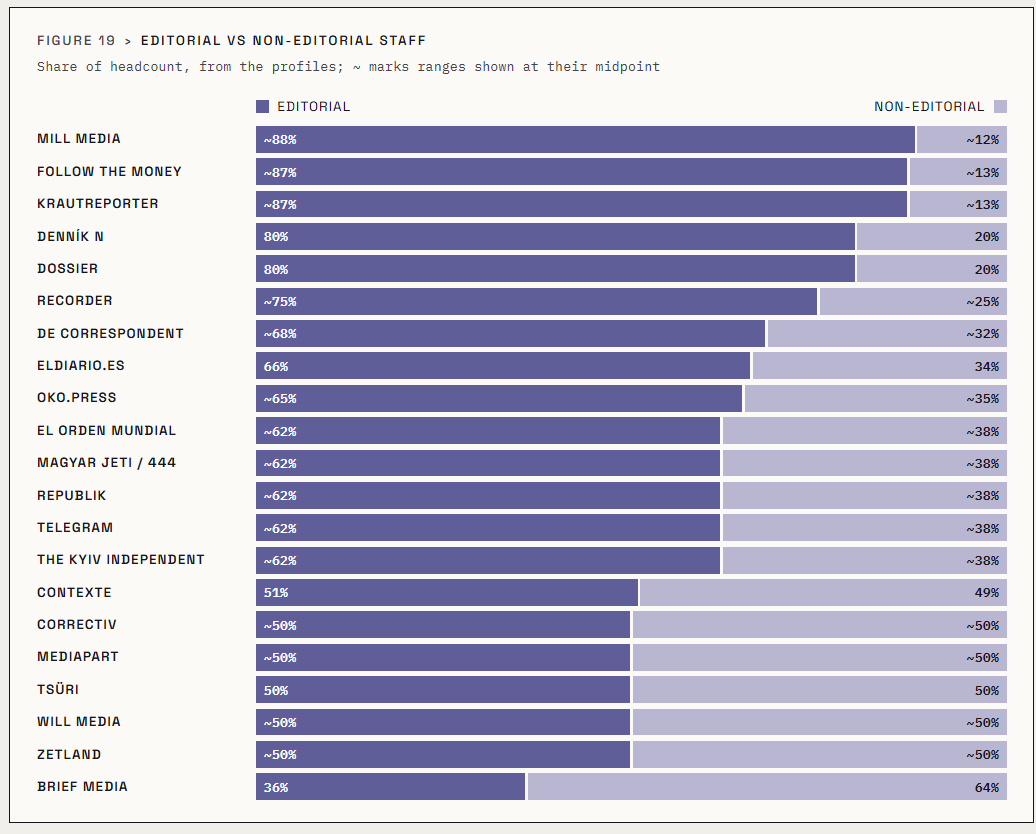
Others built mechanisms to share responsibility for sustainability. Denník N links a small part of journalists’ pay to subscription conversions. Contexte lets employees buy shares, with company loans available. Staff own about 6%.
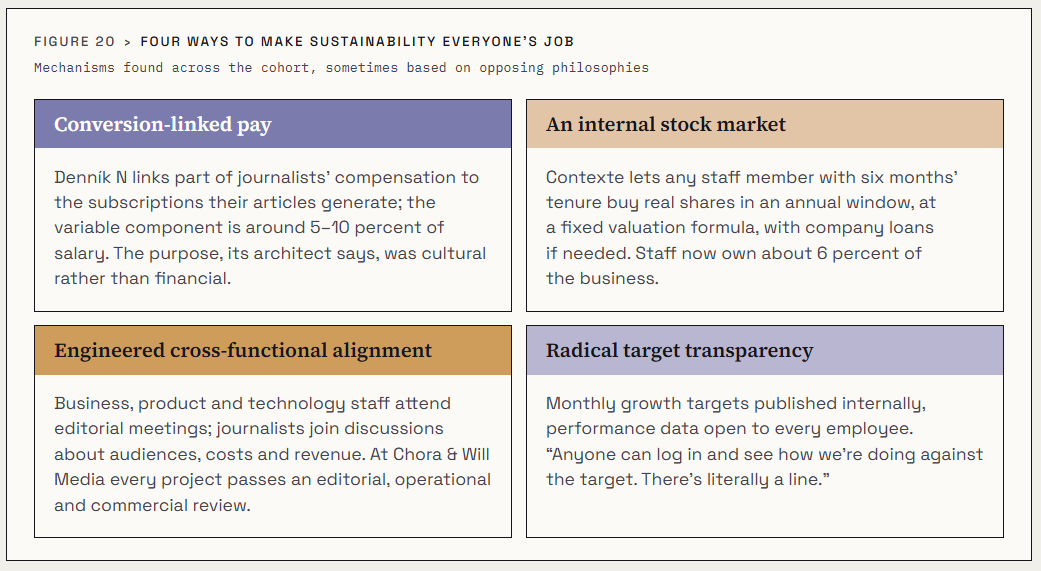
Producing excellent journalism takes people whose job is something other than producing journalism.
There is much more in the interactive report. Read them, or get in touch if you want to discuss what the findings mean for your venture or funding strategy.
This would not exist without ERSTE Foundation; the European Media and Information Fund; Limelight Foundation; Mercator Switzerland; Rudolf Augstein Stiftung; Stefan Batory Foundation; and V-Ventures, with additional support from International Media Support and Newspack at Automattic.
Thank you also to the 21 ventures, our CSM team and my co-author Milo Tesselaar, who initiated the project.
We are planning more work around it. I will try to avoid turning this newsletter into a weekly Capital Stacks update. Normal programming will resume, with occasional relapses.