


Welcome!
This week on Media Finance Monitor
The AI influencers would like to see your newsroom’s budget
Publishing less takes quite a lot of work
Print is not for people who obsess about mistakes
A local digital newsroom’s six-year road to profitability
28 active calls (4 new)
Media Finance Monitor is where newsroom leaders, funders, and media entrepreneurs come to understand how money moves through the information ecosystem. We decode funding, business models, policy, and platform shifts and turn them into strategies you can actually use.
Paid subscribers get premium editions, full access to the archive and all our research reports, for about the cost of a pistachio éclair and a good espresso a month.
For deeper engagement, our Partnership Program offers one-on-one strategic advisory, curated briefings, and access to our internal databases and invite-only events.
The AI influencers would like to see your newsroom’s budget
I check my spam folder fairly often. Partly because sometimes Google still puts important stuff there, but also because spam can be entertaining and even educational. You can learn quite a lot from what people think you might buy, and how they try to sell it to you.
In July, I received an unusually competent piece of spam, or, as its sender would probably prefer to call it, a cold outreach email.
“A publisher just asked about media finance: ‘Which grant funders are actually backing small newsrooms right now?’”
It came from a startup which offers to turn your accumulated work into a digital version of you that people can consult. Consultancy is difficult to scale without hiring more expensive people, so I could see the angle. But I’ve got used to being a single child over the past 46 years, so the prospect of having a “digital twin” was not especially appealing. Still, an interesting idea, and well-thought-out spam campaign.
I thought about the email again this week, when Patreon co-founder Sam Yam announced he was joining OpenAI to lead Creator Product, accompanied by former product head Drew Rowny and engineering head Shannon Ma.
First the obvious: that is a substantial recruitment effort, and whatever emerges, OpenAI clearly considers creators a market worth organising around.
As we have discussed here before, the existing relationship between AI and creators already puts pressure on institutional publishers.
Digital distribution came first, allowing individuals to reach audiences that previously required an institution. Then increasingly accessible subscriptions, memberships and advertising infrastructure made those audiences easier to monetise. (We discussed some of this in the piece about an apolitical beagle and the revolt of creators, still one of my favorites here.)
A person who can reach and monetise an audience comparable to a publisher’s, while carrying a fraction of its overhead, has a great competitive advantage. This creates a structural challenge for publishers on the scale of Google and Meta’s dominance of digital advertising, though it receives a lot less attention in the industry’s account of its own trials and tribulations.
But institutions still had advantages, including the resources to make things look and work professionally. Studios, production teams, designers, developers. Those advantages were already shrinking before generative AI, but they are shrinking faster now.
Take our various dashboards (on the AgoraEU programe, on income tax redirection to media, on newsletters) as modest examples. Unsurprisingly, I think they look rather sharp. More importantly, they would not exist without AI. Commissioning a development team would have made them too expensive, too slow, maybe both. A dashboard responding to yesterday’s news has limited value if it arrives 3 months later.
AI does not automatically produce good products, but it lets a small team that is willing to learn build things whose sophistication previously required substantially more money and people.
Looking professional is not the same as reporting accurately, conducting an investigation or defending it in court, but most audiences and advertiser do not pay separately for those distinctions.
OpenAI could simply be hiring people to build better creative tools, which would be useful but not especially interesting strategically. The more exciting possibility is a business around what creators already possess: distinctive expertise, recognisable identities and audiences willing to follow them.
Consider cooking. We already ask ChatGPT for recipes, and the results are generally decent. But I also follow ADIP_FOOD, whose faintly ASMR videos involve copious amounts of leeks, anchovies and eggs. I like leeks, anchovies and eggs, so there is a robust product-market fit.
Given the choice, I might prefer dinner advice drawn from his recipes and judgement over a generic answer. Imagine an interactive service built with his participation, using his work, adapting it to whatever is in my fridge. The creator could license the material, help shape the service and receive a share of the revenue. OpenAI would get a differentiated product and a reason for that creator to introduce followers to it.
The logic works for makeup, fitness, really any number of topics, perhaps even media finance, which is roughly what the spammy email was trying to sell me in July.
This would not require creators to abandon YouTube or Instagram, but give them another product to sell to people who already trust them.
The details of the arrangement (if there is an arrangement: apart from my fondness for leeks, this is mostly speculation) will matter enormously. Can creators participate on published terms, or does this become another collection of private deals for a few famous people? Who sets prices? Who keeps the customer relationship?
For publishers, a broadly accessible creator revenue programme would be an uncomfortable development: another group getting infrastructure for earning money while much of journalism is still debating on panels what fair compensation is supposed to be.
Creators would be bringing more than material for the model to consume, they would be bringing customers.
We’ll learn more soon. As always, if I’m right, I will be insufferable about it; if I’m wrong, I will make up excuses.
Publishing less takes quite a lot of work
(by Peter)
The Media Roundup has a good write-up of a Publisher Summit panel in London, where The Times, The Telegraph and Hearst UK explained how publishing less helped them grow.
The Times reported cutting sports output by around 30% while traffic rose nearly 50% year on year. Hearst also reported higher traffic from fewer articles, freeing time for membership products and newsletters.
This is a strategy I would encourage many publishers to consider and we are working with some large ones to implement versions of it. But in my experience there is a little bit of distance between a conference presentation and the operating reality of most newsrooms.
The business model has to support the strategy. Deeper engagement has a clear role in subscription conversion and retention, but if your revenues still depend on selling large volumes of advertising impressions, reducing output requires a credible plan for maintaining revenue.
Newsroom culture may also be sensitive. I’m sure many veteran readers can imagine newsrooms where asking reporters to stop covering certain things and start covering others because of audience behaviour would result in people reaching for pitchforks. An audience team with an excellent spreadsheet + deck cannot resolve this alone. You need sustained backing from editorial leadership whose judgement the newsroom respects.
Visible successes also help. Newsrooms are often competitive places, so if a reporter tries something different, produces journalism colleagues admire, and gets strong engagement or conversions, others may want to try it too.
You do need content audits, reader research, feedback and repeated adjustments, but also incentives, authority and patience.
Print is not for people who obsess about mistakes
(by Peter)
I started in print (decades ago), but had forgotten what it feels like to find a mistake immediately after sending something to the printer. Needless to say, I took it gracefully.
And yesterday I saw the first Capital Stacks of Journalism pages, pictured below. Still unbound, but looking very good. (Not on this picture, I suck at taking photos.)
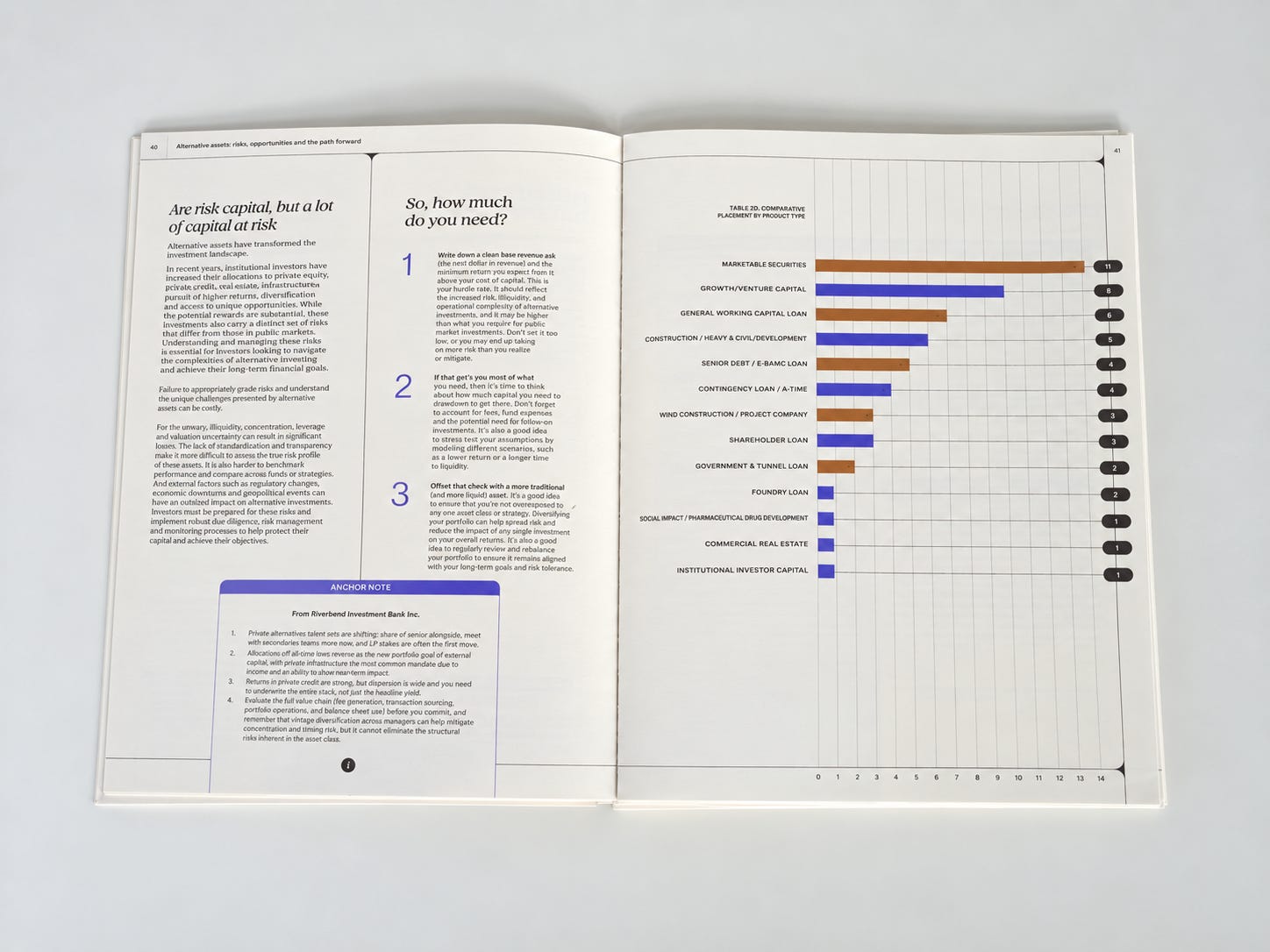
We launch on 29 September: 21 news ventures, the money that built them, and what it took them to become viable businesses. Next week’s newsletter will have a certain thematic predictability.
I’ve also been building CapitalStacks.media, and I’m rather proud of it. It’s currently a coming-soon page, but I can’t wait to push the new site out. Mercifully, that version will remain editable.
A local digital newsroom's six-year road to profitability
(by María)
Lookout Santa Cruz is a digital-only news outlet serving the California county of the same name through local reporting, daily and neighborhood newsletters, and community guides. Media analyst Ken Doctor launched it in 2020.
In 2024, it had 15 full-time staff, while advertising and reader revenue covered 75-80% of its expenses in some quarters, but not consistently. That gap has now closed. Nieman Lab reported earlier this month that the operation became profitable on earned revenue in 2026, with ads bringing in around 60% of the total and memberships 40%. The outlet says it reaches more than half of adults in the county each month.
Audience scale supported both revenue streams. For Doctor, audience size is central to the business: more readers mean greater reach for advertisers and a larger pool of potential members. Lookout has more than 40 marketing partners in each of its two markets, with deals typically ranging from $1,500 to $6,000, and expects to have more than 10,000 members across both by the end of 2026, he told A Media Operator.
Staffing accounted for most spending. Around 70% of expenses go to talent and another 10% to technology. The remainder includes offices, marketing and community events. The bulk of the budget goes to the people producing, selling and growing the product.
Profitability came after substantial outside funding. Lookout raised $2.4 million in initial capital to build its first operation, while its second newsroom, in Eugene-Springfield, Oregon, required around $3.5 million to launch. New titles are expected to take roughly three years to reach profitability now that central infrastructure and processes are in place. External support, including California's Local News Fellowship, also helped cover some newsroom staffing costs along the way.
The second launch tested whether the model could work elsewhere. Lookout chose Eugene-Springfield largely because it offered a more typical local market than Santa Cruz. It also matched characteristics the company is seeking in future locations, including a major university and a weakened chain-owned daily. Less than two years in, earned income is covering around 60% of the operation's expenses, a faster start than the first.
A third newsroom is planned for 2027, with a goal of operating in five West Coast markets by the end of 2028.

This piece is part of a series focusing on local and community journalism and is supported by the LimeNet project and the European Union.
Here are the 28 active calls (4 new), with the largest at the top: