


Welcome!
This week on Media Finance Monitor
Society pays for what helps society. People pay for what helps them.
The drive to hold AI companies accountable is gaining ground
What local news audiences actually pay for
24 active calls (3 new)
Media Finance Monitor is where newsroom leaders, funders, and media entrepreneurs come to understand how money really moves through the information ecosystem. We decode funding, business models, policy, and platform shifts and turn them into strategies you can actually use.
Paid subscribers get premium editions, full access to the archive and all our research reports, for about the cost of a pistachio éclair and a good espresso a month.
For deeper engagement, our Partnership Program offers one-on-one strategic advisory, curated briefings, and access to our internal databases and invite-only events.
Join as a free or paid subscriber.
Society pays for what helps society. People pay for what helps them.
(by Peter)
I’m in Vilnius this week for GlobalFact, talking to fact-checkers and the information-integrity crowd about money. Telling people about platforms cutting support, philanthropy shifting priorities, public money being political, and the “market” being very hard makes for really cheerful conversations. I can highly recommend it.
My title was: “Society pays for what helps society. People pay for what helps them.”
I think most of the information-integrity world lives somewhere between those two sentences and would rather not choose. I understand the reluctance.
The value of fact-checking, anti-disinformation work, and media literacy is real but diffuse. Improving the information environment benefits society in the aggregate. This is valuable but really hard to bill for. The broader and fuzzier the benefit, the harder it is to get any single person to pay for it.
This is the classic public-good/market-failure problem. When markets fail, usually the public sector or philanthropy steps in. For years, there was an elite consensus around the value of this work, which helped sustain public subsidies, philanthropic money, and platform support. In many contexts, that consensus has now cracked.
So my pitch was to take the other route seriously. If you want individuals, companies, or institutions to pay you, you need to solve a problem concrete enough, urgent enough, and useful enough that someone reaches for a card. Not “support democracy.” A patient deciding whether to take a drug, a small business trying not to get scammed, a pharmacist fielding the same misinformation twenty times a week.
The new Reuters Institute Digital News Report arrived just as I was writing the speech, and proceeded to support my argument almost suspiciously well.
(I will allow myself a tiny bit of tasteful bragging here. Jim Egan, the new lead author of the report, was generous enough to tolerate some of my unsolicited advice while the questionnaire was being developed, especially around what the survey might usefully ask on payment and motivation. I am very good at giving unsolicited advice, as friends, family, colleagues, restaurant waiters, and most recently several confused staff members at Warsaw airport can confirm. I’d like to claim credit and will settle for proximity.)
Among people who pay for online news, 81% say direct benefits are at least part of their reason for paying. Almost half also mention values-based motivations, such as supporting journalism because it matters to society, but the hierarchy is clear: a lot more people pay because the product helps them directly than because journalism is good for everyone.
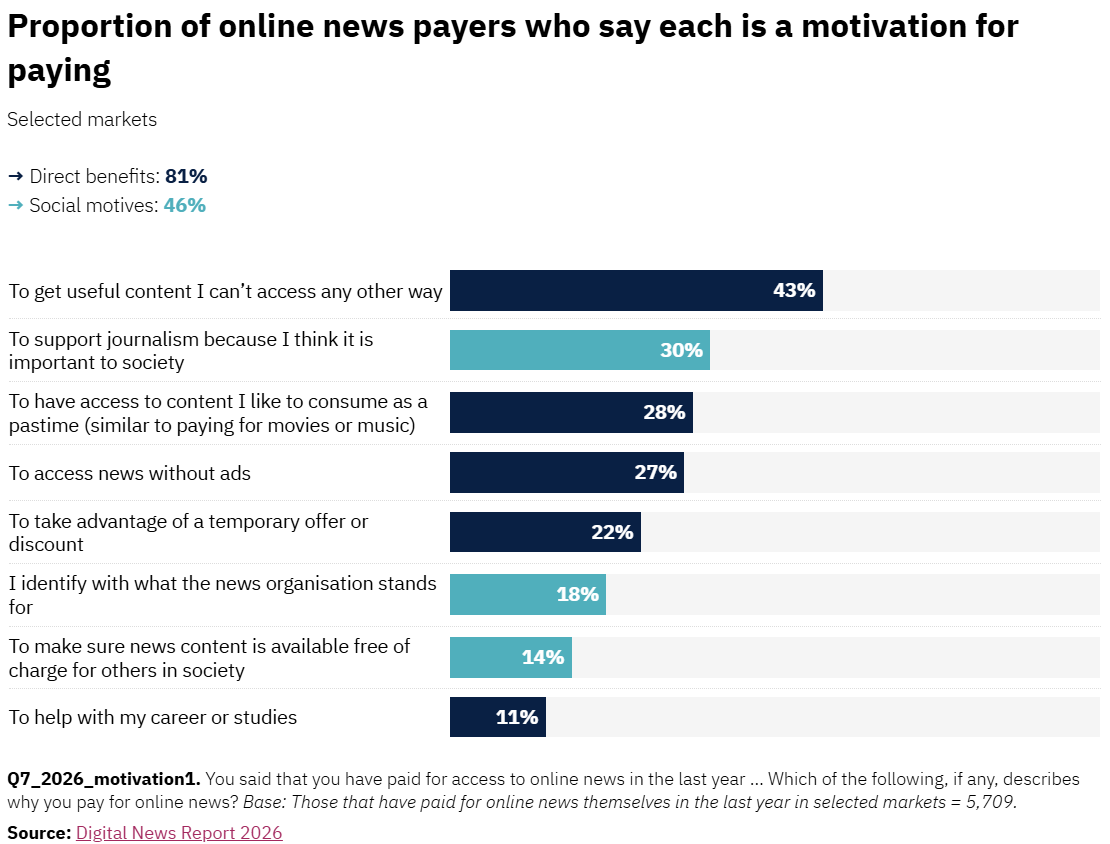
This is not some depressing finding about human nature. People can care about society and still need a personal reason to take out the credit card.
For information-integrity, this is uncomfortable because the field has often been built around the opposite logic. The work is packaged for funders, platforms, policymakers, and society in the abstract. Less often is it packaged for a specific user with a recurring problem and a reason to pay.
The DNR also shows how fast the competitive landscape is changing. Among online news payers, 56% report paying a traditional news organization, 23% pay a digital-only outlet, and 15% pay an individual.
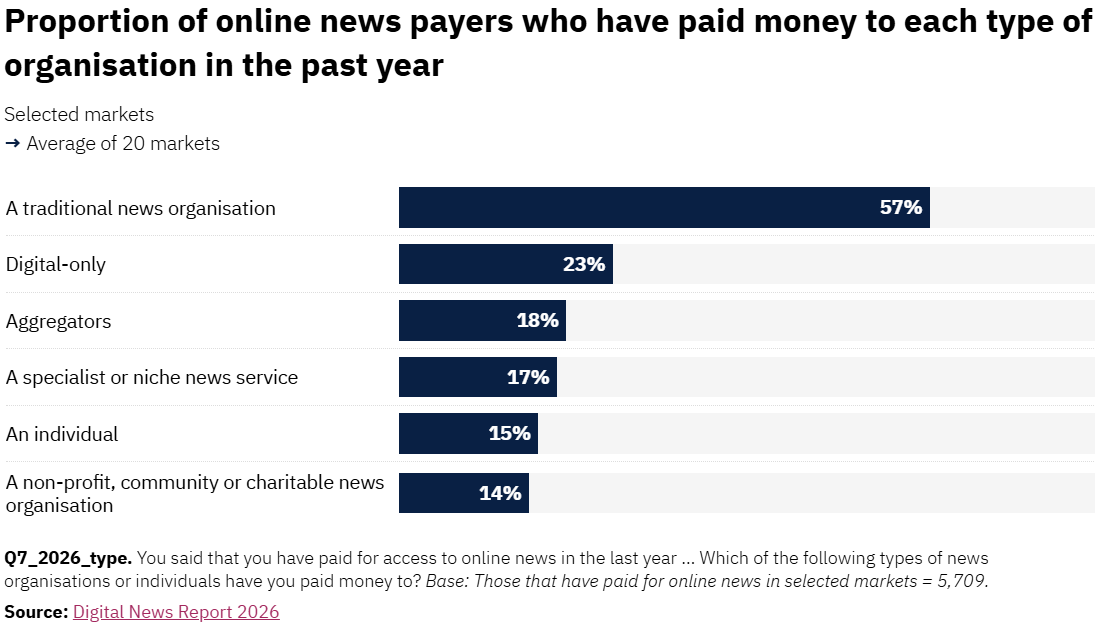
That gap between digital-only outlets and individuals is not very large, which is a very large structural problem for institutions.
Even digital-only news organizations have editors, managers, finance teams, product people, lawyers, systems, meetings, and at least one person whose job appears to involve walking slowly between rooms with a laptop and a reusable water bottle.
A creator may be one person, or a tiny team with a newsletter, podcast, YouTube channel, and direct payment relationship with an audience. If the revenue lines are becoming even vaguely comparable while the cost structures remain wildly different, the economics will become increasingly difficult for institutions.
Which brings me to how people pay, where the report and our own Capital Stacks of Journalism research point in the same direction. (I’ll say as little as possible about Capital Stacks, partly because it isn’t finished and partly out of superstition.)
Across the payment modalities, pure voluntary donation, where you get nothing in return but the warm feeling of having supported the cause, is consistently the smallest category, a minority habit even in the market where it runs highest.
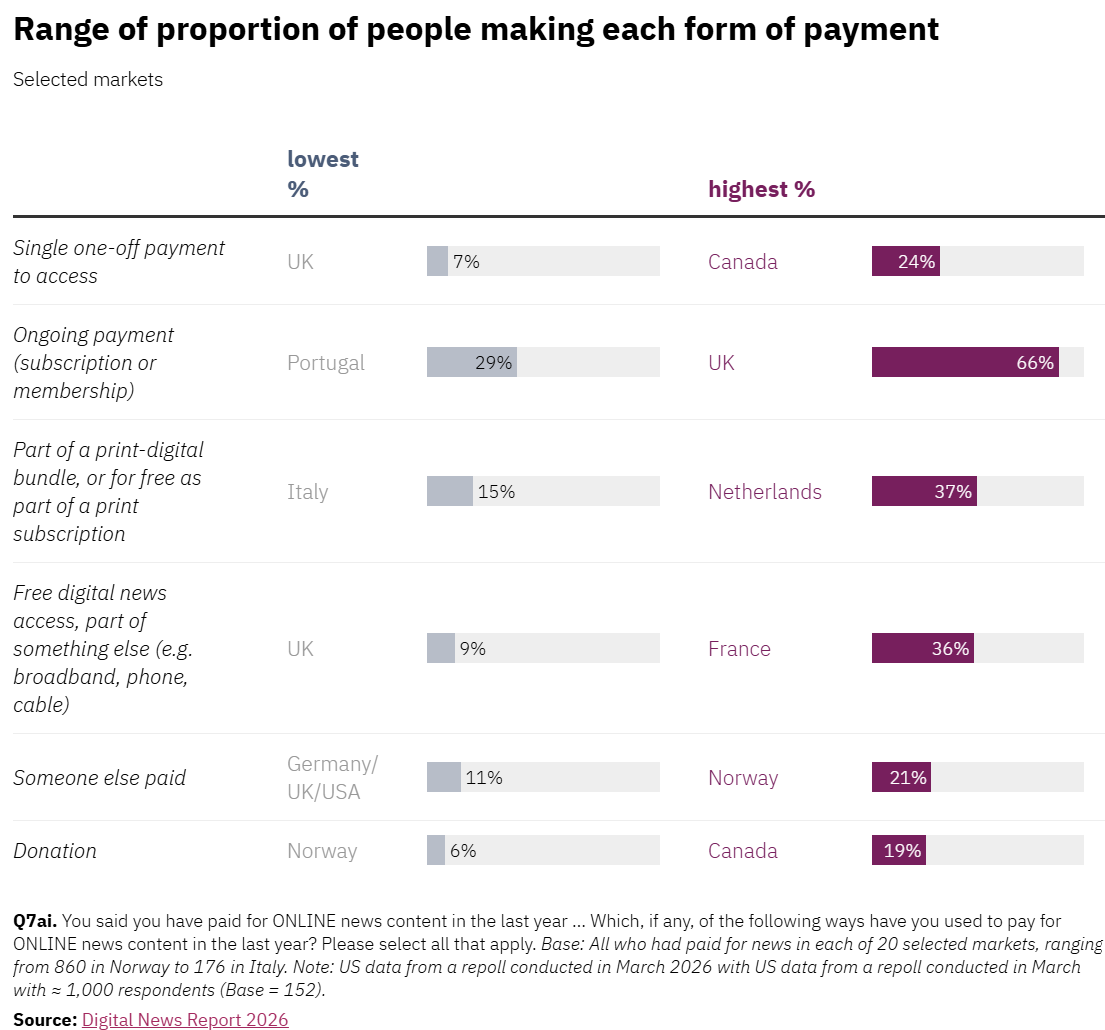
That matches what we’re seeing across the European publishers in Capital Stacks: audience revenue is the center of gravity, and the overwhelming majority gate something. Of roughly twenty outlets, perhaps two or three live on voluntary donations alone, and two of those are quietly building an exclusive product. Voluntary support is the model organizations aspire to escape, not the one they build toward.
That is also difficult for the information-integrity space, where gating content or creating exclusivity still feels alien to most operators.
So this is the uncomfortable place I left the fact-checkers of Vilnius. If your public funding is secure, defend it and serve the public. That is a gift; use it well. But if it isn’t, and for much of this field it visibly is not, then wanting market revenue without changing how you operate is not a realistic strategy.
The drive to hold AI companies accountable is gaining ground
(by María)
Publishers are trying to take a more active role in setting the conditions under which AI companies use their work. SPUR, a coalition created to develop standards and licensing frameworks around usage rights, shows how quickly that push is becoming more structured. Launched in late February by the BBC, Financial Times, Guardian, Sky News and Telegraph Media Group, it recently announced 30 new members and released draft specifications for reporting content-use events.
Others are also thinking about the usage-compensation problem. In Harvard Business Review, economist E. Glen Weyl and computer scientist Raul Castro Fernandez propose a collective royalty-style system built on two datasets AI companies already produce during model training: the data mixture (which tracks how sources are blended and reveals the relative value of each) and scaling laws (empirical estimates of how performance responds to additional data and compute). They argue those inputs are enough to price content, making the objection that paying large numbers of rights holders would be too complex overstated.
But those efforts address only one side of the debate. The other begins when AI systems turn source material into something of their own: outputs that may go beyond, or contradict, what the originals actually say. At that point, the question is who bears responsibility for the result. A preliminary ruling in Germany gives an early indication of how it can be answered.
In a dispute over false accusations in Google AI Overviews, the Munich Regional Court found the company liable for the content the feature generated as the damaging claims in the summary did not appear in the cited sources, weakening Google’s argument that it was only directing users to third-party material. The court treated the difference between retrieving and generating as legally significant: ordinary search surfaces links; an AI Overview produces something new. That was enough in this case to exclude Google from the protections available to hosting providers, including the Digital Services Act’s safe harbours.
What local news audiences actually pay for
(by María)
When a U.S. local daily opened its records to researchers Gregory J. Martin, Shoshana Vasserman, and Cameron Pfiffer, they gained access to four years of data that captured which stories people clicked and which ones led them to subscribe. The dataset included 1.2 billion user sessions, 605 million article visits, and more than 55 million individual paywall events.
Depending on the metric, reader demand looked different. Sports, entertainment and syndicated columns tended to draw traffic. Public health, local politics and economics (the kinds of coverage typically described as hard news) tended to generate subscription value. The average local news article generated roughly twice as much subscription value as the average entertainment piece.
Martin, lead author of the paper, told Nieman Lab: “Willingness to pay in attention is really different than willingness to pay in dollars”. A click can mean interest, habit, distraction or just a good headline. A paywall conversion signals a stronger commitment: money behind the decision to keep reading. Traffic shows what draws attention; subscription value shows what turns some readers into subscribers. Both matter, but they measure different things. Treat them as interchangeable, and the picture can be misleading.
At this newspaper, the most popular stories often drew casual visitors, the group least likely to subscribe, so more clicks did not necessarily mean more subscriptions. The choice of metric also has strategic implications: had it optimized for traffic, it would have expanded entertainment and cut local news. Optimized for subscription revenue, the opposite.
That data also revealed how individual behavior shifted depending on access. Before subscribing, when the paywall limited how much users could read, they were more likely to devote that scarce access to civic coverage. Once the limit disappeared, entertainment and columns took up more of the extra time. Civic coverage was diluted, but did not disappear from the mix.

This piece is part of a series focusing on local and community journalism and is supported by the LimeNet project and the European Union.
Here are the 24 active calls (3 new), with the largest at the top: