


Welcome!
This week on Media Finance Monitor
Journalism is the OG distillation attack
News is out, newsletters are in
Wordle and weeknight pasta is literally saving accountability journalism
26 active calls (7 new)
Media Finance Monitor is where newsroom leaders, funders, and media entrepreneurs come to understand how money really moves through the information ecosystem.
We decode funding, business models, policy, and platform shifts and turn them into strategies you can actually use.
Paid subscribers get premium editions, full access to the archive and all our research reports, for about the cost of a pistachio éclair and a good espresso a month.
For deeper engagement, our Partnership Program offers one-on-one strategic advisory, curated briefings, and access to our internal databases and invite-only events.
Join as a free or paid subscriber.
Journalism is the OG distillation attack
(by Peter)
I get excited when a new word drops the same ways others get excited for a new Bad Bunny album, so I was really psyched to read Anthropic’s recent press release about what they call a “distillation attack” against their model.
Anthropic says it detected “industrial-scale” campaigns by three Chinese AI labs (DeepSeek, Moonshot, and MiniMax) that used roughly 24,000 fraudulent accounts to generate 16+ million exchanges with Claude, allegedly to extract capabilities and improve their own models. The company frames this not just as competitive cheating, but as a safety issue: if you distill a frontier model, you might also distill the capabilities while leaving the safeguards behind.
I want to leave the complex geopolitical and technical implications to others, and focus on the terminological gymnastics. There is already a nice, widely understood phrase describing what these Chinese labs are trying to do: it’s intellectual property theft. Which I guess Anthropic and similar AI companies would love to avoid using given that the entire sector still has a, ahem, complicated relationship with other people’s intellectual property.
From a publisher’s perspective, the AI training story often looks like one giant, planetary-scale distillation attack. Scrape a corpus, compress it into a system that can answer questions, monetize the system and argue later about who/what fed the machine.
(One could also argue that journalism is the OG distillation attack. A reporter goes somewhere, asks questions, compresses a lot of information into something useful for their audience. Sure, the scale, speed, and means of distribution may be a little different.)
Anthropic isn’t the only AI company being creative with language this week.
OpenAI published its Signals data report, a reasonably detailed breakdown of how consumer ChatGPT is actually being used, and buried inside it is a category called “seeking information“ that is working very hard not to be called something else.
The report breaks usage into seven topics: practical guidance, writing, seeking information, self-expression, technical help, multimedia, and other. “Seeking information” accounts for roughly 18% of all messages. It sits pointedly separate from “practical guidance” (how do I do this thing?) and “technical help” (why is the red light blinking / not blinking on this thing?). Seeking information is also what you do when you want to know what happened. Some of it is, in normal English, called news consumption.
But OpenAI doesn’t want to call it that. Acknowledging a substantial “news” category in their usage data would hand publishers a useful data point in the ongoing, and very much unresolved, argument about compensation. So it becomes “seeking information“, a label that technically includes everything and specifically commits to nothing. Very neat.
Non-work usage has overtaken work usage significantly, down from roughly 50/50 in mid-2024 to about 70/30 non-work by late 2025. The data also shows who’s driving this shift: predominantly under-35, increasingly gender-balanced, and on free or entry-level plans
ChatGPT has crossed from a productivity tool into something more ambient: a place people go to figure stuff out, make sense of things, stay informed. Which sounds an awful lot like what people used to use journalism for.
According to SensorTower’s 2026 mobile trends report, ChatGPT generated $3.4 billion in in-app purchase revenue in 2025, and it is the fastest app to ever cross the $3 billion threshold.
At this point, lamenting if people would still turn to newsrooms for information the way they used to is about as useful as lamenting what the printing press did to monks doing calligraphy.
The media finance question is who gets to capture the value. Because what people are paying for is, in part, the same thing journalism has always provided: what happened, what it means, what to do about it. The delivery layer changed, but I promise you that the underlying information didn’t magically large language modelled itself into existence.
The content that makes these AI assistants genuinely useful (the recipes, the local news, the explainers, the how-tos, the what-just-happeneds, etc.) was produced by someone else, at someone else’s cost. The AI layer compresses it, personalizes it, delivers it faster and more conveniently than any individual publisher can, and captures the subscription revenue. A select group of large, mostly Global North publishers have negotiated licensing deals with OpenAI. Everyone else is, so far, providing the raw material for free.
You don’t need to be an economist to see that this is not a stable arrangement.
Either a lot of the information producers eventually go dark, which degrades the very thing that makes these models worth paying for (and, incidentally, degrades our societies along with it, but let’s not get sidetracked), or some more systematic value-sharing mechanism emerges, like what Youtube has with content creators. The distillation attack framing, the careful avoidance of the word “news”, and the reluctance to share the billions in revenue all connect to the same unresolved question. Who supplies the inputs in the information economy, and who gets to capture the value generated.
News is out, newsletters are in
(by Peter)
Pew Research Center has been doing some of the most consistently useful research for the media industry. In the past few weeks they published two studies that, read together, tell a clarifying story about what audiences care about.
The headline from the first one is bleak: just 8% of Americans say individuals have a responsibility to pay for news. 83% have not paid for any news in the past year. When asked how news organizations should primarily fund themselves, 45% say advertising and sponsorships.
One reading here could be that audiences don’t value journalism, but I don’t think that’s quite right. People pay for convenience, identity, habit, entertainment, community, self-improvement, and yes, for being reliably informed, they just don’t necessarily experience that as “paying for news”.
This is not just about terminology.
“News” is a moral category; “products” are a budget category. People don’t want a lecture about civic responsibility, they want something that earns a place in their day: a format they like, a tone they recognize, a service that saves them time or makes them smarter. Call it a newsletter, a briefing, a guide, a membership, a tool, whatever. The closer journalism gets to an audience-shaped service, the easier it is for people to pay for it without feeling like they’re being asked to subsidize an abstract institution.
The other Pew study looked at newsletter consumption and found that about 30% of Americans get news from email newsletters at least sometimes and that number climbs with income and education. Upper-income adults are at 38%; college graduates at 35%. This is where the two studies connect: the same demographic that over-indexes on newsletter consumption in one also over-indexes on believing individuals have a responsibility to pay for news in the other. College graduates are at 14% on the responsibility question, compared to 5% for those with a high school diploma or less. Upper-income adults are at 14%, lower-income at 5%.
If you’re looking for product-market fit for audience revenue, this is it.
The audience most willing to pay is already reading newsletters and our own audience surveys across Central and Eastern European markets, conducted over the past two and a half years in almost every country in the region, show the same pattern. Higher disposable income, heavier newsletter consumption. Better educated, more likely to already be paying for journalism. This isn’t a US-specific phenomenon. It’s a structural feature of who newsletters attract and who they serve.
(If you want to go deeper on the how, we published the Newsletter Playbook last year that covers the practical side of building and monetizing this kind of product. Worth a read if you’re at the stage of figuring out whether and how to make it work for your publication.)
Wordle and weeknight pasta is literally saving accountability journalism
(by Maria Paula)
Fresh 2025 results are in for two of the biggest names in media.
The New York Times’ Q4 report shows that only 1.47M of its 12.21M digital subscribers pay for news alone. The remaining 10.75M include 4.27M subscribed to standalone non-news products like The Athletic, Audio, Cooking, Games and Wirecutter; and 6.48M on bundles or multiproduct combinations. It seems like Wordle and weeknight pasta are, in a very real sense, supporting the accountability journalism the publication is known for.
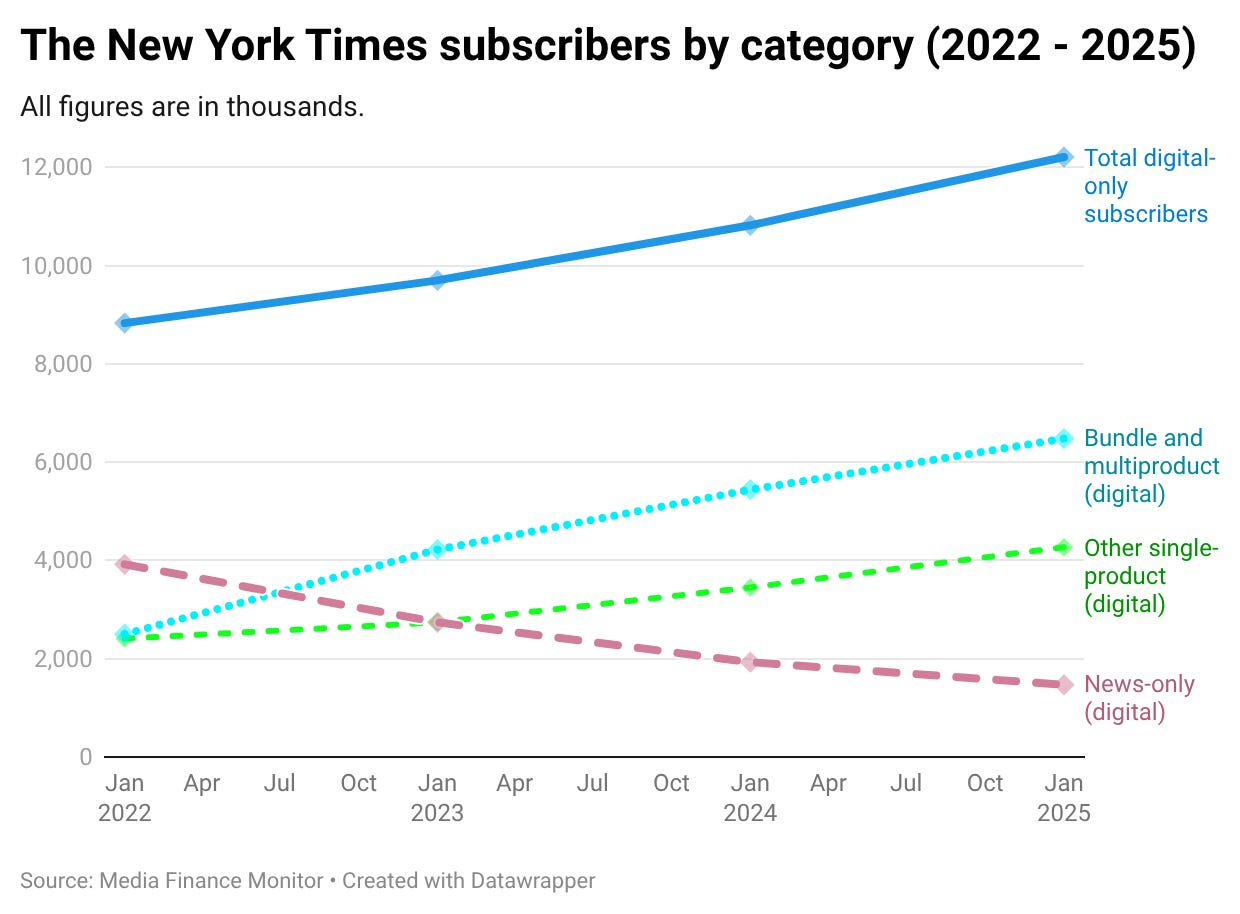
Alongside these numbers, the company announced it would stop reporting subscribers and ARPU by product category, arguing that total figures better reflect how the business is managed. Read in context, it can be about the optics: the change comes as subscriber growth is driven primarily by non-news products and, as Andrey Mir has noted, indicators that don’t tell a flattering story are the ones most likely to disappear. But it can also be structural. The NYT now operates as a portfolio of information products, from visual investigations to recommendations for noise-cancelling headphones, and what matters is the overall health of the business, not the distinction between news and non-news.
News Corp reported its Wall Street Journal closed with nearly 4.7 million total subscribers, including 4.3 million digital, up 13% and 11% from 2024. That growth didn’t have to do with recipes or puzzles. Their core offer is information that drives decisions and moves markets. For people working in business, operating in finance, or leading publicly listed companies, it offers coverage they rely on. Not staying current carries a real cost. This is high-utility, high-impact reporting with clear providence.
Both cases show there’s willingness to pay for useful information, whether that means helping people cook gochujang buttered noodles, hedge a position, or understand what their government is doing. What’s a struggle is selling journalism purely on values. If your pitch is built primarily around abstract ideas like democracy and the public interest, your market is likely to be smaller and the business harder to sustain.
Here are the active calls, with the largest at the top: